Luxury Solid Wood and Natural Stone Bathroom Cabinet Models: Craftsmanship, Sealing Science, and Stone Pairing
Integrating organic timber and quarried stone into high-humidity wet zones represents the pinnacle of bespoke residential joinery. While synthetic polymers and engineered laminates dominate entry-level installations, luxury solid wood and natural stone bathroom cabinet models bring unmatched tactile warmth, geological uniqueness, and multi-decade heirloom durability to master suites and spa-inspired interiors. However, marrying hygroscopic timber and porous natural stone with steam, standing water, and thermal fluctuations requires specialized joinery techniques and chemical protection protocols.
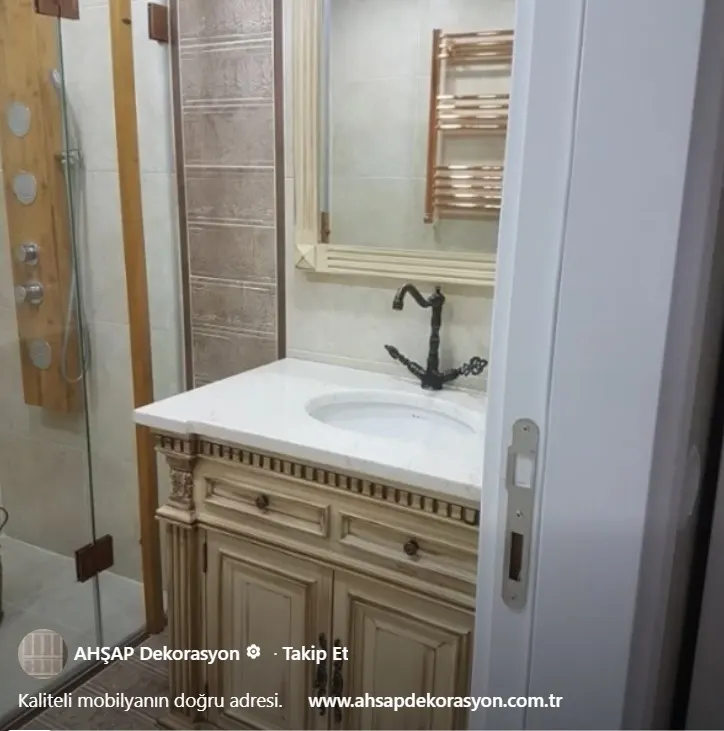
This comprehensive architectural guide explores the wood species selection, kiln-drying standards, stone slab engineering, structural reinforcement, and long-term preservation methods behind luxury solid wood and natural stone bathroom cabinet models.
1. Timber Selection: Dimensional Stability in High-Humidity Environments
Not all hardwoods perform reliably in bathrooms. Wood is hygroscopic—it continuously absorbs and releases atmospheric moisture until it reaches equilibrium moisture content (EMC) with its surroundings. When relative humidity swings from 40% to 90%, unstable timber expands across the grain, leading to split panels, warped doors, and failed glue joints.
Luxury solid wood and natural stone bathroom cabinet models rely on timber species with low tangential-to-radial shrinkage ratios and high natural oil or resin content:
• Burmese or Plantation Teak (Tectona grandis): Widely regarded as the gold standard for marine and wet-zone architecture. Teak contains high levels of natural silica and oleoresins that repel water, prevent fungal decay, and resist warping even without heavy surface film coatings.
• American Black Walnut (Juglans nigra): Prized for its rich chocolate heartwood and straight, fine grain. Walnut exhibits moderate dimensional movement and machines cleanly for precision fluted fronts and mitered waterfall edges.
• Rift-Sawn White Oak (Quercus alba): Unlike red oak—whose open pores wick water like microscopic straws—white oak possesses closed cellular vessels (tyloses) that block moisture penetration. Specifying rift-sawn or quarter-sawn cuts ensures the annual growth rings run nearly perpendicular to the board face, minimizing seasonal expansion by up to 50% compared to plain-sawn lumber.
• Thermally Modified Ash and Pine (ThermoWood): Timber baked at 180°C to 215°C in an oxygen-free steam chamber undergoes permanent chemical restructuring. The process breaks down hemicellulose (the nutrient source for mold and rot) and drops the wood's equilibrium moisture content by roughly half, yielding ultra-stable dark timber ideal for modern luxury solid wood and natural stone bathroom cabinet models.
Timber Species Janka Hardness (lbf) Tangential Shrinkage (%) Natural Rot Resistance Visual & Architectural Profile
Teak 1,070 4.7% Exceptional (Marine-grade) Warm golden-brown, subtle dark streaking
Rift White Oak 1,360 8.6% (reduced via rift cut) High (Closed pores) Linear, tight grain, light honey to neutral taupe
American Walnut 1,010 7.8% Moderate to High Deep espresso brown with purplish undertones
Thermally Modified Ash ~1,320 < 4.0% (post-treatment) Very High Rich caramelized dark brown, pronounced grain
2. Joinery Engineering for Hygroscopic Wood Movement
Even the most stable hardwood moves seasonally. Master cabinetmakers design luxury solid wood and natural stone bathroom cabinet models to accommodate expansion without tearing the carcass apart:
1. Kiln-Drying to 6%–8% Moisture Content: Lumber must be kiln-dried to match conditioned indoor climates before milling. Building cabinets from air-dried timber (12%–15% moisture) guarantees shrinkage cracks once central heating or air conditioning operates.
2. Floating Center Panels in Frame-and-Panel Doors: Traditional Shaker or raised-panel solid wood doors never glue the center panel rigidly into the surrounding stiles and rails. Instead, the panel floats inside deep grooves with rubber "space balls" that absorb lateral wood expansion during humid summer months.
3. Engineered Core with Thick Solid Wood Staves: For flat-panel minimalist designs, builders laminate 3-to-4-millimeter solid hardwood veneers over a balanced marine-grade plywood or blockboard core, wrapped with 10-millimeter solid wood edge bands. This hybrid construction preserves the authentic look and sandability of solid wood while eliminating wide-board cupping.
4. Waterproof Type-I Structural Adhesives: All mortise-and-tenon, dowel, and biscuit joints must be bonded using ANSI/HPVA Type-I waterproof PVA glues (such as Titebond III) or structural polyurethane adhesives rather than standard interior woodworking glues.
3. Natural Stone Countertops and Integrated Carved Basins
Topping luxury solid wood and natural stone bathroom cabinet models with quarried stone creates an unmistakable focal point, provided the stone's mineralogy aligns with bathroom usage habits.
Marble (Carrara, Calacatta, Nero Marquina)
Marble is a metamorphic calcium-carbonate rock prized for dramatic veining and luminous depth.
• Architectural Reality: Because marble is calcium-based, it reacts chemically with acidic substances (lemon juice, vinegar-based cleaners, certain exfoliating skincare acids), creating dull "etch" marks. Specifying a honed (matte) finish rather than a high-gloss polish makes micro-etching virtually invisible while enhancing the stone's velvety, organic feel.
Quartzite (Taj Mahal, Sea Pearl, Perla Venata)
Often confused with engineered quartz, natural quartzite is a metamorphic sandstone compressed under extreme tectonic heat.
• Architectural Reality: Quartzite rivals granite in hardness (7 on the Mohs scale), resists acid etching completely, and offers the sweeping, translucent veining of fine Italian marble—making it the premier low-maintenance choice for luxury solid wood and natural stone bathroom cabinet models.
Soapstone and Basalt
Dense, non-porous metamorphic and volcanic stones that require zero chemical sealers. Soapstone is completely impervious to acids and staining agents, developing a rich charcoal patina over time when treated with mineral oil.
Monolithic Mitered Aprons and Carved Stone Sinks
High-end installations frequently feature mitered waterfall edges (80 to 120 millimeters thick) where the stone's veining wraps seamlessly down the front apron, or CNC-carved monolithic stone basins where the sink bowl is milled directly from a solid 150-millimeter block of marble or travertine with a concealed linear slot drain.
4. Structural Load Engineering for Heavy Stone Slabs
A 3-centimeter thick natural stone slab weighs approximately 80 to 90 kilograms per square meter. When paired with a solid marble apron and undermount basin, the countertop assembly on a 150-centimeter double vanity can easily exceed 160 kilograms before water fills the bowls.
• Full-Depth Structural Web Frames: Unlike laminate cabinets that rely on thin top corner gussets, luxury solid wood and natural stone bathroom cabinet models require full-width solid hardwood stretchers (minimum 22 millimeters thick) spanning front-to-back across the top of the carcass every 45 to 60 centimeters.
• Cantilevered Steel Concealed Brackets: When installing a floating solid wood vanity topped with natural stone, standard wall-hanging brackets are insufficient. Structural L-shaped welded steel brackets (10-millimeter plate steel) must be bolted directly into masonry walls or welded to structural steel wall framing before drywall and tile installation, projecting forward beneath the cabinet box to carry the stone's dead load directly to the building frame.
5. Protective Finishes: Penetrating Oils vs. Catalyzed Coatings
Protecting solid timber in a wet bathroom requires balancing natural wood texture against water-repellent barrier performance.
• Two-Component (2K) Polyurethane Matte Varnish: Forms a cross-linked, crystal-clear chemical shield over the wood fibers. Modern "raw-wood effect" dead-matte 2K coatings (sheen level 3%–5%) protect timber from standing water, toothpaste, and cosmetics while looking and feeling nearly identical to unfinished sanded wood.
• Catalyzed Conversion Varnish: An industrial-grade resin finish widely used in custom architectural millwork. Once cured, it offers superior moisture and chemical resistance compared to standard lacquers.
• Hardwax Oils (Rubio Monocoat, Osmo Polyx-Oil): Molecularly bond with the top cellulose fibers of the wood rather than forming a surface plastic film. Hardwax oils preserve warm grain texture and allow effortless spot-repairing of scratches without sanding the entire cabinet, though they require periodic maintenance coats every 12 to 24 months in splash zones.
6. Stone Impregnation and Preventative Maintenance Protocols
Even dense natural stones contain microscopic capillaries that can absorb colored soaps, hair dyes, and hard-water minerals.
1. Fluoropolymer Penetrating Sealers: Apply a breathable, solvent- or water-based impregnating sealer immediately after installation. Unlike topical wax coatings that sit on the surface and peel, penetrating sealers migrate 3 to 5 millimeters into the stone's pores, lowering surface tension so water and oils bead up on top without blocking water vapor escape.
2. pH-Neutral Cleaning Discipline: Never clean natural stone or finished hardwood bathroom cabinet models with bleach, ammonia, citric acid, or abrasive scouring powders. Use strictly pH-neutral stone soaps and microfiber cloths.
3. Controlled Indoor Humidity: Maintain bathroom relative humidity between 45% and 60% via quiet, continuous-run exhaust ventilation or timer-controlled fans to keep both timber joints and stone sealers performing across decades.