Vanity Cabinet Faucet Mounting Options in Hotels: Deck-Mounted, Wall-Mounted and Basin-Mounted Taps
Deck-, wall- and basin-mounted taps each change the vanity top, the backsplash and where water lands. This guide compares them from the joinery side so you can specify the right one early.
The main vanity tap mounting options in hotels are deck-mounted, wall-mounted and basin-mounted. Each one changes how the cabinet top is cut, how high the backsplash must be and where water ends up after a guest washes their hands. Choosing the tap late often means redrawing the top, so it is worth deciding together with the cabinet design.
This guide looks at the question from the joinery and fit-out side. It is written for procurement managers, designers and contractors who need to coordinate the tap with the vanity top before production starts.
Why the tap type drives the cabinet design
A tap is not only a plumbing item. It decides where the top needs holes, whether the wall behind the basin must carry pipework, how deep the top has to be and how much of the surface stays wet.
Three things change with every tap type:
- The vanity top: hole positions, thickness, reach and basin position.
- The backsplash or wall panel: height, cut-outs and sealing details.
- Splash behaviour: where water lands, how it drains and what the housekeeping team has to wipe.
Deck-mounted taps
A deck-mounted mixer sits on the countertop or on the rim of the top. It is the most common arrangement in hotel bathrooms, and it keeps the plumbing inside the cabinet rather than in the wall.
What it changes in the top
The top needs a tap hole, or three holes for a widespread set, drilled at an accurate distance from the basin edge. Stone, quartz and solid surface tops are normally drilled in the workshop, so the hole positions must be confirmed on the shop drawings before cutting. A hole drilled in the wrong place in a stone slab cannot be repaired invisibly.
The top should also be thick enough, or locally reinforced, to take the tap nut and the clamping load. Check the tap supplier's data sheet for the maximum panel thickness the fixing can accommodate.
What it changes in the backsplash
Because the tap sits close to the wall, water tends to run down the wall and settle at the junction between the top and the backsplash. A low upstand of a few centimetres may be enough where the wall is tiled and sealed. Where the wall is painted or covered with a panel, a taller splash panel is the safer choice.
Splash behaviour
- Water falls into the basin from a modest height, so splashing is generally manageable.
- Drips collect on the deck around the tap base, so the base should have a clean seal and a gentle fall on the top.
- A tall spout over a shallow basin splashes more than a low spout over a deep basin.
Wall-mounted taps
A wall-mounted tap projects from the wall above the basin, with the mixer body either exposed on the wall or concealed behind a plate. It gives a clean, uncluttered top and is popular in upscale and boutique projects.
What it changes in the top
The top needs no tap holes, which simplifies stone cutting and leaves a clear surface for amenity trays. However, the basin must be positioned so that the spout reaches the centre of the bowl. A spout that is too short pours onto the basin rim, and one that is too long can strike the back of the bowl.
The top depth and basin position must therefore be agreed with the tap's projection dimension. This is a coordination point between the cabinet maker, the plumber and the tap supplier.
What it changes in the backsplash
This is where the biggest change happens. The wall behind the vanity now carries the tap, so it needs:
- a solid backing, such as a plywood or steel plate, if the wall is drywall;
- concealed pipework and a rough-in box, set at a height that matches the basin;
- a sealed finish around the plate, since the tap sits above the splash zone and can drip down the wall surface.
If the vanity includes a full-height wall panel in HPL, solid surface or stone, the cut-outs for the tap body must be drawn precisely. Panels are often made before the plumbing is final, so a small installation tolerance in the rough-in can mean a visible gap around the plate.
Splash behaviour
Wall-mounted taps keep the deck dry and easy to wipe, which housekeeping teams appreciate. On the other hand, water that runs down the wall behind the tap goes straight to the junction with the top, so a sealed, well-detailed upstand is important. Spout height also matters: a high tap above a shallow basin will splash more.
Basin-mounted taps
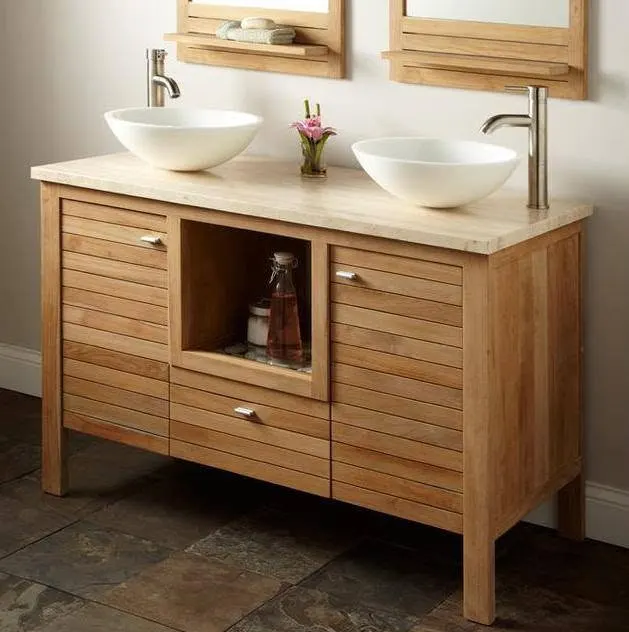
Basin-mounted taps are fixed to the basin itself. They are common with vessel basins and some integrated basins, where the tap hole is formed in the basin or on its rim. The tap may be a tall vessel mixer standing on the countertop beside the basin.
What it changes in the top
Where the tap hole is in the basin, the top needs only the basin cut-out or a flat surface to sit on. With a tall vessel mixer, there is usually a hole in the top, as for a deck-mounted tap, but the position is tied to the basin location. The tap supplier's template and the basin template should be checked together.
Basin-mounted taps also need the basin to be strong at the tap hole. Thin ceramic or cast stone bowls require careful handling, and any torque applied during installation is a risk.
What it changes in the backsplash
Because the tap is within or beside the basin, the wall behind it is usually less involved. A standard splash zone is generally enough. A vessel basin sits proud of the top, so water that splashes off the bowl lands on the deck rather than inside it.
Splash behaviour
- Tall vessel taps give good clearance for washing hands but can send water outside a shallow bowl.
- The area around the base of the basin collects water and soap residue, so the top needs a gentle fall and a well-sealed edge.
- Housekeeping must wipe both the basin and the deck, which adds a little to room turnaround.
Side-by-side comparison
| Factor | Deck-mounted | Wall-mounted | Basin-mounted |
|---|---|---|---|
| Holes in the top | One or three, accurately positioned | None | Depends on basin type |
| Wall preparation | Minimal | Backing and concealed pipework | Minimal |
| Backsplash demand | Moderate | High, with sealed tap cut-outs | Moderate |
| Deck cleanliness | Water collects at tap base | Clear deck, easiest to wipe | Water collects around basin base |
| Plumbing access | From inside the cabinet | Through the wall or a service panel | From inside the cabinet |
| Coordination risk | Hole positions in the top | Spout reach and rough-in height | Basin and tap templates |
How the choice affects the vanity design
Depth of the top
Wall-mounted taps often need more top depth so that the spout reaches the bowl centre, while deck-mounted taps need enough space between the basin and the wall for the tap body. In compact bathrooms, this can decide whether a slim unit works at all.
Backsplash material and height
If you choose a wall-mounted tap, think of the backsplash as a functional wall surface, not a trim. Use a material that tolerates constant water contact, and plan the tap cut-outs at the shop drawing stage.
Maintenance access
Deck-mounted and basin-mounted taps are usually serviced through the cabinet, so the cabinet interior needs clear space and an easy route to the isolating valves. Wall-mounted taps are serviced from the wall side, so you need either a removable service panel or a concealed access point behind the vanity.
Hotel operations
Think about how the bathroom is used. A family hotel with children may prefer a simple deck-mounted mixer that is easy to reach. A design-led boutique property may prefer the cleaner deck of a wall-mounted tap and accept the extra wall coordination. In both cases, the question to ask is how long housekeeping will spend per room and how often water marks will show.
Coordination checklist before ordering
- Fix the tap model before the vanity top drawings are approved, not after.
- Get the tap manufacturer's technical drawing, including projection, spout height and hole diameter.
- Check that the basin template and the tap template match on the same drawing.
- Confirm the mounting height of wall-mounted taps against the basin rim and the mirror position.
- Agree who supplies the wall backing and the rough-in box.
- Check the maximum top thickness that the tap fixing can accept.
- Test the arrangement on a mock-up vanity with the actual tap, running water, before approving the full order.
Common mistakes to avoid
- Drilling the top before the final tap model is confirmed.
- Choosing a short wall-mounted spout that does not reach the bowl centre.
- Using a painted or porous wall finish behind a wall-mounted tap.
- Forgetting that a tall vessel mixer needs room to swing the handle without hitting the wall or mirror.
- Leaving no access to the isolating valves.
Conclusion
No single tap type is best for every hotel. Deck-mounted taps are practical and easy to service, wall-mounted taps give a cleaner top but demand a more careful wall, and basin-mounted taps suit design-led basins but need attention to splash and cleaning. What matters most is that the tap is chosen early and drawn precisely together with the top and backsplash.
If you are planning a hotel bathroom project, send us your bathroom drawings and the tap data sheets. We will review the vanity top, the backsplash and the hole positions with you and come back with a quotation and suggestions for your project.
Sıkça Sorulan Sorular
Which tap mounting type is easiest for hotel housekeeping?
Wall-mounted taps leave the vanity top clear, so there is less around the tap to wipe. Deck-mounted taps are also straightforward if the base is well sealed. Tall vessel mixers tend to take longer, because water collects around both the basin and the deck.
Do wall-mounted taps need a special backsplash?
Yes, the wall behind the tap needs a solid backing, a concealed rough-in and a water-tolerant finish, such as tile, HPL, solid surface or stone. Cut-outs for the tap plate should be drawn precisely, because small plumbing tolerances can leave visible gaps.
Can I change the tap type after the vanity top is ordered?
It is difficult and often costly. Stone and solid surface tops are drilled to a specific tap model, and moving a hole is rarely possible. Fix the tap model and obtain its technical drawing before the top is approved for production.
How do I stop splashing with a vessel basin and tall tap?
Match the spout height and position to the bowl so the stream falls inside the basin, ideally near the centre. A deeper bowl and a lower-flow aerator help. A mock-up with running water is the most reliable way to check the result.
Where should I access the plumbing for each tap type?
Deck-mounted and basin-mounted taps are generally serviced through the cabinet interior, so leave clear space and reach to the isolating valves. Wall-mounted taps are serviced from the wall side, so plan a removable panel or concealed access point.
Every hotel project is different. Send us your drawings or room schedule for a tailored proposal on materials, lead time and shipping.