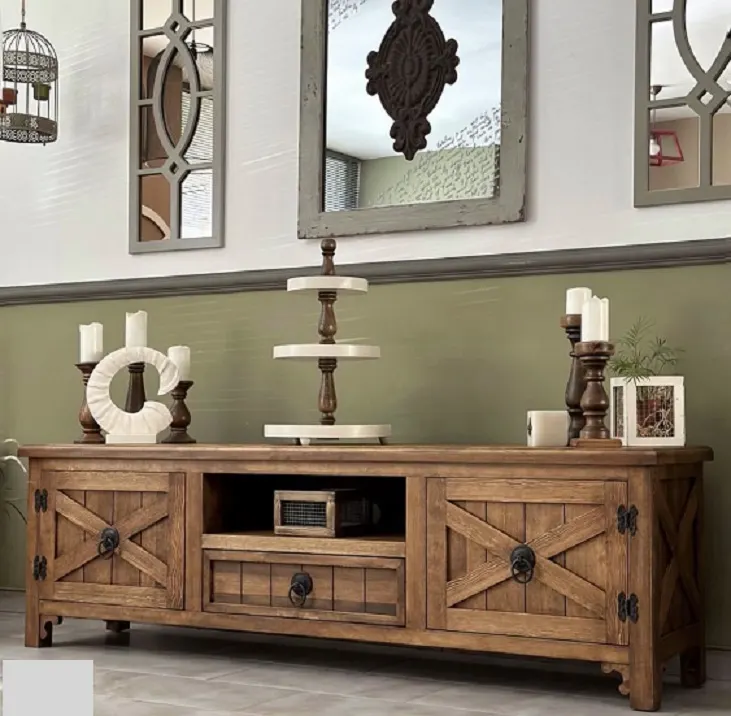
Scientific Colorimetry and Batch Patina Standardization: Spectrophotometer Quality Control, CIELAB Delta-E Tolerances, and Finishing Consistency for Aged and Distressed Solid Wood TV Units i
In international B2B solid wood furniture trade, subjective visual inspection is one of the most frequent catalysts for costly commercial disputes. When an international retail merchandising director in Munich, London, or New York approves a hand-distressed, ammonia-fumed Wildeiche (wild oak) or cerused American walnut media console prototype, they expect Container #1 delivered in spring and Container #4 delivered in autumn to exhibit cohesive visual harmony on the showroom floor.
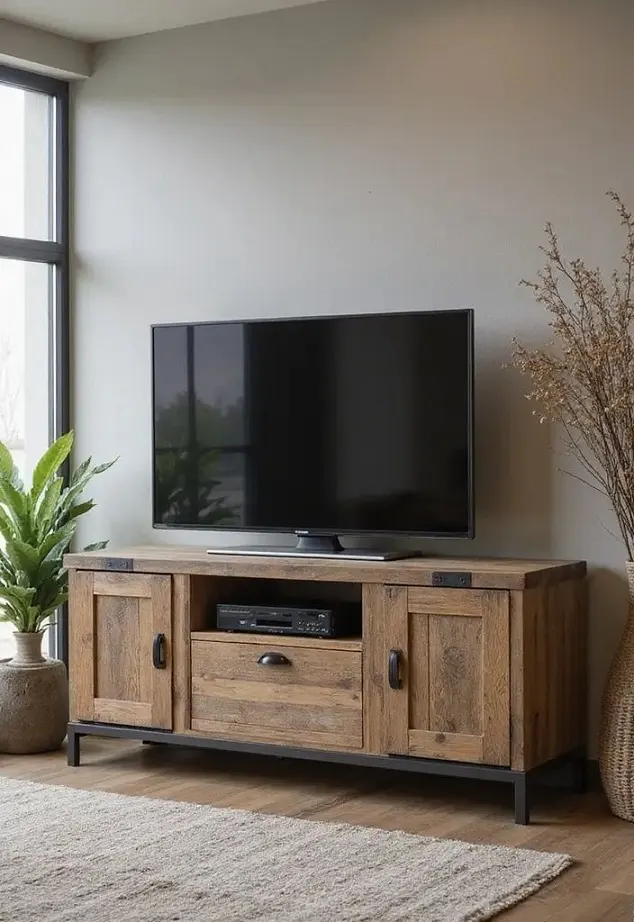
Yet timber is an organic, biologically variable substrate—mineral content, heartwood-to-sapwood ratios, earlywood-to-latewood density, and tannin concentration vary from log to log and even from board to board. When manufacturing solid wood TV units with an aged and distressed look in Türkiye, relying solely on the naked eye of a finishing booth supervisor under inconsistent factory fluorescent lighting leads to inevitable batch color drift. Scientific Colorimetry and Batch Patina Standardization: Spectrophotometer Quality Control, CIELAB Delta-E Tolerances, and Finishing Consistency for Aged and Distressed Solid Wood TV Units in Türkiye provides an authoritative, laboratory-grade quality engineering manual for finishing chemists, quality assurance directors, retail category managers, and Turkish export executives deploying quantitative color science across weathered solid wood production lines.
Across Türkiye’s leading woodworking clusters in İnegöl (Bursa), Siteler (Ankara), Istanbul, and İzmir, progressive export factories are replacing subjective visual guesswork with objective optical metrology—combining multi-angle portable spectrophotometers, standardized D65 daylight viewing booths, CIELAB (\(L^{*}a^{*}b^{*}\)) color-space tolerances, 60-degree specular gloss meters, and calibrated Light/Medium/Dark Patina Master Range Boards. By pairing raw hardwood sapwood-equalization chemistry with quantitative color tolerances, Turkish manufacturers deliver authentic, multi-tonal aged patinas that preserve natural wood grain individuality while remaining strictly locked within commercial retail color boundaries.
Throughout Scientific Colorimetry and Batch Patina Standardization: Spectrophotometer Quality Control, CIELAB Delta-E Tolerances, and Finishing Consistency for Aged and Distressed Solid Wood TV Units in Türkiye, we dissect the optical physics of weathered wood surfaces—explaining CIELAB (\(L^{*}a^{*}b^{*}\)) and Δ E₀₀ color-difference mathematics on textured, wire-brushed substrates; managing natural tannin and extractive variance across imported North American and European hardwoods; engineering sapwood-blending pre-stains and fuming chamber controls; establishing standardized D65/TL84 metamerism-checking protocols; and integrating quantitative color tolerances into bilingual B2B supply contracts and Pre-Shipment Inspection (PSI) checklists.
1. The Optical Physics of Weathered Timber: Why Distressed Wood Challenges Color Measurement
Measuring color on a solid oak or walnut media console is fundamentally more complex than measuring painted automotive sheet metal or injection-molded plastics. Under Scientific Colorimetry and Batch Patina Standardization: Spectrophotometer Quality Control, CIELAB Delta-E Tolerances, and Finishing Consistency for Aged and Distressed Solid Wood TV Units in Türkiye, quality engineers account for four distinct optical phenomena inherent to aged solid hardwood:
1. Anisotropic Grain & Directional Light Scattering:
Wood fibers act like bundles of microscopic hollow tubes (vessels and tracheids). Depending on whether a board is quarter-sawn, rift-sawn, or flat-sawn—and whether light strikes parallel or perpendicular to the grain—reflected light intensity shifts dramatically.
2. Three-Dimensional Topography From Rotary Wire-Brushing (Fırçalama):
On solid wood TV units with an aged and distressed look in Türkiye, rotary steel-wire brushes excavate softer springwood valleys (0.4–0.8 mm deep) while leaving dense latewood ridges raised. Furthermore, dark antique glazes or white cerusing pastes settle deliberately inside the recessed valleys while wiping clean off the raised ridges—creating intentional multi-tonal micro-contrast across every square centimeter.
3. Extractive & Tannin Concentration Variance:
When using reactive aging processes—such as vapor-phase ammonia fuming (füme meşe) or aqueous iron-acetate tannin washes—color intensity depends directly on the natural tannin content of each individual oak or chestnut stave. Boards harvested from older heartwood sections darken more deeply than boards cut near younger outer growth rings.
4. Metamerism Across Showroom vs. Home Lighting:
Two distressed walnut finishes that appear identical under cool 4000K factory LED lights in Bursa may look noticeably different—one greenish, one reddish—under warm 2700K incandescent/LED lighting in a London or New York living room. This phenomenon, known as illuminant metamerism, occurs when pigment spectral reflectance curves diverge across wavelengths.
2. CIELAB (\(L^{*}a^{*}b^{*}\)) Color Space & Δ E₀₀ Mathematics for Solid Wood Consoles
To eliminate subjective arguments over whether a production batch is "too dark," "too red," or "too yellow," engineers executing Scientific Colorimetry and Batch Patina Standardization: Spectrophotometer Quality Control, CIELAB Delta-E Tolerances, and Finishing Consistency for Aged and Distressed Solid Wood TV Units in Türkiye quantify surface appearance using the CIE 1976 \(L^{*}a^{*}b^{*}\) color model and the CIEDE2000 (Δ E₀₀) perceptual color-difference formula:
• \(L^{*}\) (Lightness Axis — 0 to 100): Measures brightness from pure black (0) to diffuse white (100). For sun-bleached driftwood oak patinas, \(L^{*}\) typically sits between 58 and 66; for smoked mushroom taupe oak, 40 to 48; for antique espresso walnut, 24 to 32.
• \(a^{*}\) (Red-Green Axis — -128 to +127): Positive \(+a^{*}\) values indicate warm red/mahogany undertones; negative \(-a^{*}\) values indicate cool green/olive undertones. Controlling \(+a^{*}\) prevents bleached oak finishes from turning unnaturally pinkish.
• \(b^{*}\) (Yellow-Blue Axis — -128 to +127): Positive \(+b^{*}\) values measure warm golden/amber/yellow undertones; negative \(-b^{*}\) values measure cool blue/ashy tones. Monitoring \(b^{*}\) detects premature ambering or UV yellowing.
Realistic Δ E₀₀ Tolerances for Textured Distressed Hardwoods
While painted plastics enforce Δ E₀₀ ≤ 1.0, natural textured solid wood requires realistic, statistically valid tolerances calibrated to open-pore grain variation:
Patina Finish Category Aperture & Measurement Protocol Maximum Single-Point Δ E₀₀ vs. Master Target Batch Average Δ E₀₀ Tolerance (Across 10 Readings) Specular Gloss Tolerance (60° Gloss Meter)
Pigmented / Opaque-Tinted Distressed Finishes Large-aperture (16–20 mm) sphere spectrophotometer (d/8° SPIN) Δ E₀₀ ≤ 2.5 Δ E₀₀ ≤ 1.8 ± 2.0 GU (e.g., 6–10 GU dead-matte)
Semi-Transparent Stain & Glazed Patinas Large-aperture (20 mm) averaging 10 clear-grain spots per console Δ E₀₀ ≤ 3.5 Δ E₀₀ ≤ 2.5 ± 2.0 GU
Reactive Ammonia-Fumed & Cerused Open-Pore Oak Large-aperture (20 mm) averaging 12 spots + Light/Dark Range Boards Δ E₀₀ ≤ 4.2 (bounded strictly between Light & Dark Range Masters) Δ E₀₀ ≤ 3.0 ± 2.0 GU
Instrument Selection Rule: Always specify a large-aperture (16 mm to 25 mm measurement spot) integrating-sphere spectrophotometer (d/8° geometry in Specular Component Included — SPIN mode) rather than a tiny 4 mm aperture device, so each reading averages across multiple earlywood valleys and latewood ridges simultaneously.
3. Upstream Timber Equalization & Fuming Chamber Process Controls
Preventing color drift starts long before spray finishing—it requires upstream wood preparation on the Turkish factory floor. Under Scientific Colorimetry and Batch Patina Standardization: Spectrophotometer Quality Control, CIELAB Delta-E Tolerances, and Finishing Consistency for Aged and Distressed Solid Wood TV Units in Türkiye, finishing chemists enforce four upstream process controls:
1. Incoming Lumber Batch Sorting & Sapwood Segregation:
When rough-sawn European White Oak (Quercus robur) or American Black Walnut (Juglans nigra) exits the drying kiln at 8.0%–10.0% MC, rough-mill graders sort staves by baseline heartwood tone and restrict sapwood to ≤ 5% on visible top faces. Prior to panel gluing, pale sapwood edges receive a targeted sapwood-equalizing dye wash matched to heartwood \(L^{*}a^{*}b^{*}\) values so reactive stains absorb uniformly.
2. Computer-Controlled Ammonia Fuming Parameters (Füme Meşe):
Because tannin content varies between timber lots, Turkish fuming chambers regulate three variables digitally: ammonia gas concentration (ppm), chamber temperature (24°C ± 1°C), and wood moisture content (8.5% ± 0.5% MC) (since moisture acts as the chemical catalyst for ammonia-tannin oxidation). Operators pull a sacrificial test coupon through an airlock port at Hour 18 and Hour 24, measuring \(L^{*}a^{*}b^{*}\) with a spectrophotometer and halting gas injection the exact moment target lightness (\(L^{*}\)) is reached.
3. Gravimetric Stain & Hardwax Oil Mixing:
Instead of volumetric cup-mixing, finishing kitchens in İnegöl and Istanbul blend multi-component Rubio Monocoat, Renner, and ICA stains and glazes on 0.1-gram precision digital scales using barcode-verified batch recipes—eliminating human formulation drift.
4. Controlled Wet-Film Thickness & Wipe-Back Timing:
When applying hand-rubbed antique glazes or white cerusing pastes, technicians regulate spray gun air pressure, fluid nozzle orifice, and exact dwell time (e.g., 4 minutes ± 30 seconds before wiping back with lint-free pads) so recessed grain valleys retain consistent pigment density.
4. Standardized Visual Inspection Infrastructure: D65 Light Booths & Master Range Boards
Even with digital spectrophotometers, human visual verification remains essential for evaluating overall patina harmony, hand-planed edge rub-through, and epoxy knot fill aesthetics. Implementing Scientific Colorimetry and Batch Patina Standardization: Spectrophotometer Quality Control, CIELAB Delta-E Tolerances, and Finishing Consistency for Aged and Distressed Solid Wood TV Units in Türkiye establishes a strict visual grading environment:
• Multi-Illuminant Color Assessment Cabinets (D65, TL84, and A Lamps):
Every tier-one export finishing line and QC inspection room operates a calibrated 5-light-source color viewing booth painted in neutral Munsell N7 matte grey:
• D65 (6500K Northern Daylight): Primary international benchmark for evaluating overall \(L^{*}a^{*}b^{*}\) color accuracy.
• TL84 / F11 (4000K Commercial Store Fluorescent/LED): Simulates European and North American retail showroom lighting.
• Illuminant A / Horizon (2856K / 2300K Warm Incandescent): Simulates evening residential living room lighting—immediately revealing any hidden metamerism between adjacent door panels or between a console and matching sideboards.
• Triple-Board Master Boundary Architecture (Light Limit, Ideal Target, Dark Limit):
Rather than relying on a single Golden Sample swatch—which inevitably fails to capture natural wood grain variance—the Turkish factory and international buyer sign and date three physical 30 cm × 40 cm solid wood control boards at prototype approval:
1. Master Target Board (Nominal \(L^{*}a^{*}b^{*}\) Centerpoint).
2. Acceptable Light Boundary Board (Upper \(L^{*}\) Limit / Mildest Distressing & Minimum Knot Density).
3. Acceptable Dark Boundary Board (Lower \(L^{*}\) Limit / Heaviest Patina & Maximum Knot Density).
Any production unit falling visually and spectrophotometrically inside the envelope defined by the Light and Dark Boundary Boards is contractually acceptable; any unit falling outside triggers immediate rework prior to packing.
5. Contractual Color Governance & Pre-Shipment Inspection (PSI) Protocol
To embed Scientific Colorimetry and Batch Patina Standardization: Spectrophotometer Quality Control, CIELAB Delta-E Tolerances, and Finishing Consistency for Aged and Distressed Solid Wood TV Units in Türkiye into binding commercial agreements, procurement directors incorporate four clauses into their Master Supply Agreements:
1. Master Control Board Retention & UV Protection: Sealed Master Range Boards are stored inside light-tight, climate-controlled drawers at both the buyer’s QC office and the Turkish factory (replaced every 12 months to prevent natural wood oxidation drift).
2. Mandatory Spectrophotometer & Gloss Meter Audit During PSI: During ISO 2859-1 Level II Pre-Shipment Inspection, the third-party inspector records 10 large-aperture spectrophotometer readings and 6 specular gloss readings across sampled consoles, documenting average Δ E₀₀ and gloss values directly inside the official PSI report.
3. Intra-Unit Component Matching Rule: Even when overall batch Δ E₀₀ falls within tolerance, adjacent doors, drawer fronts, and waterfall sides on the same individual console must maintain Δ E₀₀ ≤ 1.5 relative to one another so mismatched planks never appear side-by-side on a single piece.
4. Batch-Matched Field Touch-Up Kit Verification: Confirm that every carton includes a 15 ml vial of pigmented hardwax oil or dead-matte touch-up lacquer formulated from the exact spectrophotometrically verified production lot.
Conclusion: Turning Optical Metrology Into Global Retail Consistency
As established throughout Scientific Colorimetry and Batch Patina Standardization: Spectrophotometer Quality Control, CIELAB Delta-E Tolerances, and Finishing Consistency for Aged and Distressed Solid Wood TV Units in Türkiye, marrying artisanal weathered woodcraft with quantitative optical science eliminates one of the greatest operational risks in international solid wood furniture trade. By combining large-aperture CIELAB spectrophotometer tolerances, digitally controlled ammonia fuming and gravimetric stain mixing, D65/TL84 metamerism verification booths, and signed Light-to-Dark Patina Boundary Boards, Turkish manufacturers and global retail brands ensure that every container of aged and distressed solid wood TV units delivers authentic natural individuality alongside dependable showroom consistency.