Vanity Cabinet Models for Hotels Using Reclaimed or Recycled Materials: What Works and What to Avoid
A recycled material vanity cabinet can work in a hotel bathroom, but only if each material is matched to its exposure to water, cleaning and traffic. This guide separates realistic options from risky ones.
A recycled material vanity cabinet can perform well in a hotel bathroom, but only when the material is chosen for its role in the unit and its exposure to water. Reclaimed timber, recycled-content boards and recycled surfaces behave very differently from virgin materials, and "eco" labels say little about how they will look after three years of housekeeping.
This article looks at what is realistic for hotel projects anywhere in the world. It focuses on wet-area performance rather than marketing claims, so you can decide where recycled materials add value and where they add risk.
Start by separating the types of recycled material
"Recycled" covers several quite different things. Treating them as one category is the first mistake in many specifications.
- Reclaimed timber: solid wood salvaged from old buildings, barns, ships, pallets or furniture, then re-milled or used with its original surface.
- Recycled-content boards: particleboard or MDF made partly from recovered wood fibre, which is very common and often already present in standard panels.
- Recycled-content surfaces: solid surface, terrazzo-style or composite tops that include recycled stone, glass or plastic.
- Recycled metal and hardware: stainless steel and aluminium typically contain recycled content as a normal part of production.
- Upcycled or composite panels: boards pressed from plastic, textile, paper or agricultural waste, with highly variable performance.
Each of these has a different moisture profile, so each needs its own assessment.
Reclaimed wood vanity in a hotel: where it works
A reclaimed wood vanity hotel design is attractive because of its character: old grain, nail holes, colour depth and a story guests notice. The challenge is that this timber has already lived through decades of movement, and its history is rarely documented.
Good uses
- Open washstand frames and legs: structural timber away from direct splashing, finished with a durable sealer.
- Shelves and towel ledges: thin elements that can be replaced easily and are wiped rather than soaked.
- Decorative veneer or thin cladding: reclaimed timber sliced or planed thin and bonded to a stable substrate, which reduces movement.
- Bathrooms with good ventilation and a separate wet zone: where the vanity is outside the shower splash area.
Risky uses
- Solid reclaimed fronts and drawer boxes next to the basin: the repeated wet and dry cycles can cause cupping, cracking and open joints.
- Bottom panels and plinths: these sit closest to mop water and standing moisture.
- Unknown-origin timber: boards that previously contacted chemicals, preservatives or pests need checking before they enter a guest room.
A practical approach is to use reclaimed timber as a skin or a frame and let a stable, moisture-resistant core do the structural work.
Checks to make before approving reclaimed timber
Reclaimed material is not standard stock, so the factory and the buyer should agree on how it will be controlled. Without this, the first batch and the last batch can look and perform differently.
- Source and history: ask where the timber comes from and what it was used for before.
- Species and consistency: confirm that the species is identified and the supply is large enough for the whole order.
- Treatment: check for pest treatment, heat treatment or kiln drying, and ask for documentation where available.
- Moisture content: timber should be conditioned to suit the destination climate before it is machined.
- Metal and contamination: old nails and fixings must be removed and the boards inspected before cutting.
- Finish system: the sealer or lacquer should be tested on a sample board, including underside and edges.
Some countries also apply import and quarantine rules to used or untreated timber. Check these early, because they can affect shipping and clearance for any wood product.
Recycled board vanity cabinet carcasses: what to know
A recycled board bathroom cabinet often means a carcass made of particleboard or MDF with recovered fibre content. This is not a problem in itself, since many standard boards already include recycled wood. What matters in a bathroom is the moisture-resistant grade, the edge sealing and the surface laminate, not the recycled percentage.
- Moisture-resistant grade: specify a board intended for humid conditions, and do not assume that a recycled board is automatically suitable for wet areas.
- Emission class: recycled fibre can raise questions about glue and contaminants, so request the emission classification from the board supplier.
- Surface protection: HPL or a well-sealed laminate on all faces helps protect the core.
- Edges and cut-outs: these are where water enters, whatever the board type.
Where you want to cut moisture risk further, consider moisture-resistant boards for the lower sections and keep recycled-content panels for upper or dry elements.
Recycled-content tops and surfaces
Countertops made with recycled glass, stone chips or resin composites can look distinctive and handle water well when properly made. Because the products vary widely by manufacturer, ask for data sheets rather than relying on a general claim of sustainability.
- Check water absorption, stain resistance and cleaning chemical compatibility.
- Confirm that cut-outs for basins and tap holes can be made reliably.
- Review the weight, since some composites are heavy and need strong wall fixing or support.
- Ask for a physical sample and test it with the products your housekeeping team actually uses.
Materials to treat with caution
Some recycled and upcycled materials are better suited to display than to daily hotel use. Be careful with any panel that has not been tested for wet areas.
- Pressed plastic or textile panels: can look interesting but may scratch, discolour or lack a proven fire rating.
- Agricultural fibre boards: performance depends heavily on the binder and the manufacturer.
- Pallet wood: origin and treatment history can be unclear, so it needs particular scrutiny.
- Unfinished or oil-only surfaces: these absorb water, cosmetics and cleaning chemicals faster than sealed finishes.
Fire performance also deserves attention. Requirements differ by country and building type, so confirm what applies to bathroom joinery in your destination before choosing an unusual material.
Model options that suit recycled materials
Some vanity layouts are naturally more forgiving of reclaimed or recycled elements than others.
| Vanity model | Suited recycled element | Main caution |
|---|---|---|
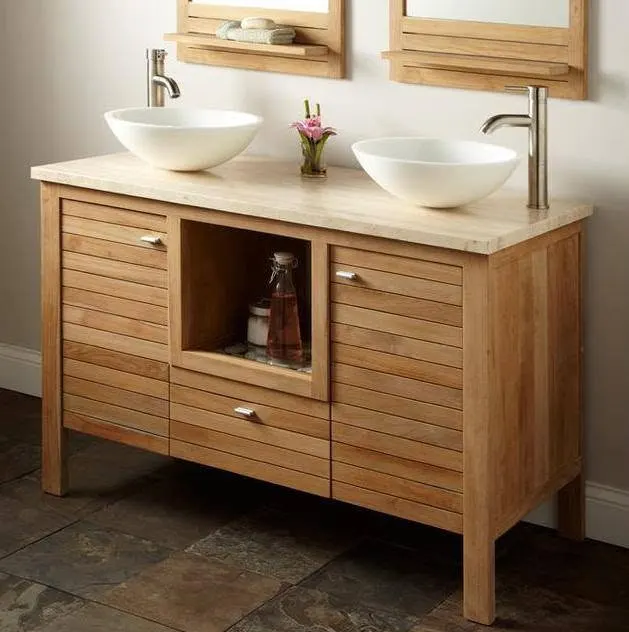
| Open washstand with legs | Reclaimed timber frame, recycled-content top | Protect timber from direct splash and floor water |
| Wall-hung cabinet | Reclaimed veneer fronts on a moisture-resistant core | Wall fixing and weight |
| Floor-standing cabinet | Recycled-content carcass with HPL surface | Plinth and bottom edge sealing |
| Console with shelf | Reclaimed timber shelf, metal frame with recycled content | Shelf finish and replaceability |
How to claim sustainability honestly
Hotel owners often want a sustainable vanity design that they can describe to guests and certification bodies. Avoid vague statements. Instead, rely on documents you can actually obtain, such as board data sheets, timber origin information and supplier declarations. If a material has no paperwork, it is better to describe it plainly than to over-claim.
Also remember that durability is part of sustainability. A vanity that swells and is replaced in three years has a bigger footprint than a simpler unit that lasts much longer.
Plan a sample before you commit
For any project using reclaimed or recycled materials, ask for a finished sample and, ideally, a mock-up vanity before full production. Run a simple water exposure test on edges and joints, check colour variation across several pieces, and confirm how the unit is cleaned. This stage is where most surprises show up while changes are still inexpensive.
Next step
If you are considering a recycled material vanity cabinet for a new hotel or a renovation, send us your bathroom drawings and target finishes. We will review which elements can use reclaimed or recycled materials, suggest a stable construction and come back with a quotation and sample plan.
Sıkça Sorulan Sorular
Can reclaimed wood be used in a hotel bathroom vanity?
Yes, but it works best as a frame, shelf or thin veneer on a stable, moisture-resistant core. Solid reclaimed fronts and bottom panels near the basin are more likely to move or crack. Good ventilation, proper sealing and a tested finish are essential.
Are recycled board bathroom cabinets suitable for humid areas?
They can be, provided the board is a moisture-resistant grade and all edges, cut-outs and faces are sealed. The recycled content itself is not the deciding factor. Check the data sheet for swelling and emission class before ordering.
Does reclaimed timber need special checks before export?
Yes. You should confirm species, treatment history and moisture content, and check that old fixings are removed. Some countries apply quarantine or import rules to untreated or used wood, so confirm requirements for your destination early.
Are recycled-content countertops durable enough for hotels?
Many are, but quality varies by manufacturer. Ask for data on water absorption, stain resistance and cleaning chemical compatibility, and test a sample with your housekeeping products. Also check weight and cut-out feasibility.
How can a hotel describe a sustainable vanity design honestly?
Base statements on documents you can obtain, such as board data sheets, timber origin information and supplier declarations. Avoid vague claims. A durable, repairable unit that lasts longer is also a credible part of a sustainability story.
Every hotel project is different. Send us your drawings or room schedule for a tailored proposal on materials, lead time and shipping.