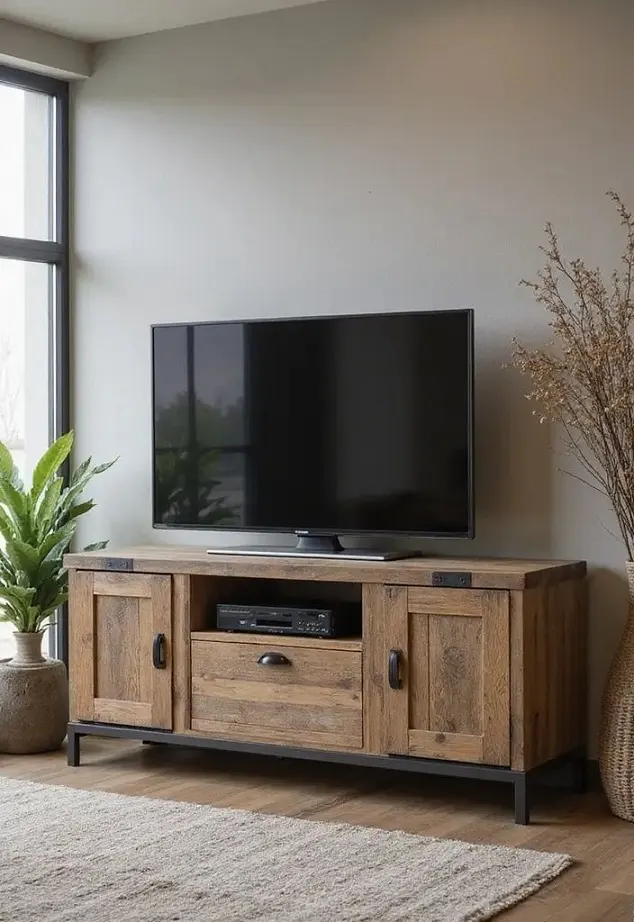
Modern Solid Wood TV Units: Structural Architecture, Acoustic Engineering, and Contemporary Living Room Design
Selecting modern solid wood TV units requires balancing clean architectural minimalism with rigorous structural engineering, timber science, and thermal management for contemporary home theater hardware. Unlike mass-produced media cabinets manufactured from melamine-wrapped particleboard or medium-density fiberboard (MDF), modern solid wood TV units utilize kiln-dried hardwoods, concealed mechanical joinery, and precision airflow channels designed to support oversized OLED panels and high-output audio systems for decades. This comprehensive technical guide examines the material mechanics, structural span engineering, acoustic optimization, ergonomic proportions, and sustainable finishing systems that define high-performance modern solid wood TV units.
1. Material Engineering: Hardwood Performance in Modern Solid Wood TV Units
Contemporary interior design favors crisp edges, floating silhouettes, and uninterrupted horizontal planes. Achieving these clean lines without warping, cracking, or structural sagging requires selecting hardwood species with high dimensional stability, superior Janka hardness, and low tangential-to-radial (T/R) shrinkage ratios.
Comparative Timber Specification Matrix
When evaluating modern solid wood TV units, timber density and cellular structure determine how well the console resists surface indentation from heavy speaker spikes, electronics feet, and daily wear:
Timber Species Janka Hardness (lbf) Modulus of Rupture (psi) T/R Shrinkage Ratio Contemporary Aesthetic & Structural Profile
Quarter-Sawn White Oak (Quercus alba / robur) 1,360 14,830 1.8 (Highly stable) Tight straight grain, subtle medullary ray fleck, exceptional span rigidity
American Black Walnut (Juglans nigra) 1,010 14,600 1.4 (Benchmark stability) Deep espresso-chocolate heartwood, minimal movement near warm electronics
European Ash (Fraxinus excelsior) 1,320 15,000 1.7 (Moderate-Low) Bright creamy-blonde grain, high shock elasticity, ideal for Nordic/Japandi styles
Hard Sugar Maple (Acer saccharum) 1,450 15,800 2.0 (Requires strict kiln control) Ultra-fine closed pores, uniform pale tone, maximum surface dent resistance
Burmese & Plantation Teak (Tectona grandis) 1,070 14,080 1.8 (Oily/stable) Natural silica and oil content, warm golden-brown hue, mid-century modern icon
Sweet Chestnut (Castanea sativa) 710 11,400 1.6 (Stable) Lightweight strength, rich natural tannins, expressive architectural grain
Kiln-Drying Standards and Equilibrium Moisture Content (EMC)
Because wood is hygroscopic, it continuously absorbs and releases moisture as indoor relative humidity shifts between winter heating and summer cooling cycles.
• Mandatory 6%–8% Moisture Content (MC): Timber milled for modern solid wood TV units must be professionally kiln-dried to 6%–8% MC prior to surfacing. Lumber dried only to air-dry levels (14%–18% MC) shrinks rapidly in climate-controlled living rooms, leading to split panels and separated miter joints.
• Stress-Relief Conditioning: Quality sawmills run a final high-humidity conditioning cycle in the kiln to equalize moisture tension from the core to the outer shell of each plank, preventing internal stresses from twisting boards after milling.
• Alternating Stave Lamination: Wide solid tabletops are engineered by laminating narrow kiln-dried staves (70 mm to 110 mm wide) with alternating growth-ring orientations (bark side up, bark side down). This counterbalances natural cupping forces and maintains a dead-flat horizontal plane across wide spans.
2. Structural Engineering: Span Rigidity, Joinery, and Floating Installations
Contemporary televisions routinely measure 65, 77, or 85 inches diagonally, demanding media consoles spanning 180 cm to 280 cm (71 to 110 inches). Engineering modern solid wood TV units across these widths without mid-span deflection requires specialized structural architecture.
Eliminating Beam Deflection (Sag) Across Wide Spans
In structural mechanics, beam deflection (\(\delta \)) increases with the cube of the unsupported span length (\(L^{3}\)) and decreases with the cube of board thickness (\(t^{3}\)). To eliminate long-term creep under heavy loads:
1. Minimum Slab Thickness: Primary top decks and load-bearing horizontal shelves should measure 28 mm to 38 mm (1.1" to 1.5") in finished thickness.
2. Concealed Steel C-Channels: For ultra-minimalist floating tops or thin-profile silhouettes, builders route longitudinal channels into the underside of the hardwood slab and insert 6 mm structural steel C-channels with slotted bolt holes—reinforcing rigidity while allowing lateral wood expansion.
3. Recessed Center Support Plinths: Freestanding modern solid wood TV units wider than 160 cm (63 inches) require a concealed fifth (and optionally sixth) center support leg fitted with threaded leveling glides to transfer vertical loads directly into the floor.
Modern Architectural Joinery Techniques
Clean, fastener-free exteriors rely on hidden precision joinery that locks the cabinet geometry while accommodating seasonal timber movement:
• Reinforced 45-Degree Mitered Waterfall Corners: Minimalist modern solid wood TV units often wrap continuous grain from the horizontal top down the vertical side panels. Artisans reinforce these long-grain miters with internal hardwood splines or loose tenons (Domino joinery) to maximize glue surface area and prevent corner separation.
• Haunched Mortise-and-Tenon Base Cradles: Where slender architectural legs meet horizontal stretchers, deep mortise-and-tenon joints resist lateral racking forces when heavy equipment is moved.
• Sliding Dovetails & Figure-8 Tabletop Fasteners: Solid wood tops are never screwed rigidly to cabinet carcasses through fixed holes. Instead, steel figure-8 fasteners or Z-clips seated in routed kerf grooves allow the top panel to expand and contract across its width without splitting.
• Half-Blind Dovetail Drawer Boxes: Media drawers endure constant pulling forces. Interlocking dovetail joints lock solid hardwood drawer sides to fronts, paired with 10 mm veneered plywood bottoms seated in routed dado grooves.
3. Floating Wall-Mounted vs. Freestanding Plinth Architecture
One of the defining choices in modern solid wood TV units is selecting between a wall-mounted floating console and a floor-standing base.
Engineering Requirements for Floating Solid Wood Consoles
Wall-mounted units create an unobstructed floor plane that visually enlarges smaller living rooms and simplifies robotic vacuum access, but they introduce significant cantilever shear and pull-out loads:
• Continuous Interlocking Aluminum or Steel Cleats: Heavy-duty extruded aluminum French cleats or 6 mm steel L-brackets must span the full rear width of the unit and anchor directly into structural wall studs (every 40 cm / 16 inches) or solid masonry using structural lag bolts or chemical anchors.
• Internal Torsion-Box Subframes: A concealed hardwood torsion grid built into the cabinet floor transfers downward bending moments from the front edge back into the wall-mounted ledger rail, preventing forward tilt.
• Static Load Capacity: Properly installed floating modern solid wood TV units should be rated for at least 120 kg to 160 kg (265 to 350 lbs) of combined cabinet mass and AV equipment—though heavy 77-inch or 85-inch televisions should always be wall-mounted independently above a floating console rather than resting directly on it.
Freestanding Plinth and Metal-Base Designs
• Recessed Shadow-Gap Plinths: Setting a solid hardwood plinth base 50 mm to 75 mm back from the front and side edges creates a sleek "floating on the floor" shadow reveal while distributing heavy loads continuously across the entire footprint.
• Powder-Coated Steel Cradle Frames: Combining warm walnut or white oak cabinetry with matte black or brushed bronze welded steel frames adds slim visual lightness alongside extreme torsional rigidity.
4. Home Theater Integration: Thermal Airflow, Acoustics, and Concealed Wiring
Modern solid wood TV units must conceal complex audio-visual electronics without causing thermal throttling, remote-control interference, or acoustic distortion.
Thermal Management for AV Receivers and Gaming Consoles
High-wattage AV receivers (AVRs), stereo amplifiers, and modern gaming consoles (PlayStation 5, Xbox Series X) generate 150W to 450W of continuous heat.
• Passive Chimney Convection: Each enclosed equipment bay should incorporate a 40 mm (1.5 inch) cool-air intake slot along the bottom rear floor and a matching 40 mm warm-air exhaust gap at the top rear edge. Cool air enters beneath the unit, rises across the electronics, and exits behind the console.
• Thermostatic Whisper-Quiet Fans: For high-power amplifiers housed behind closed doors, integrate ultra-quiet (<18 dBA) 120 mm PWM exhaust fans controlled by a thermal probe that activates automatically once internal bay temperatures reach 32°C (90°F).
Acoustic Transparency and IR/RF Signal Pass-Through
Solid hardwood fronts block infrared (IR) remote signals and muffle concealed speakers. Contemporary millwork solves this through engineered door textures:
• Fluted & Slatted Solid Timber Fronts: Vertical hardwood slats spaced 8 mm to 12 mm apart backed with dark acoustic grille fabric allow IR remote beams and sound waves to pass cleanly while disguising electronics.
• Perforated Timber & Natural Cane Inserts: CNC-slotted hardwood panels or hand-woven octagonal cane webbing provide up to 45% open airflow area while adding tactile architectural contrast.
• Center-Channel Speaker Placement: When placing a center speaker on top of the unit, align its front baffle flush with the front edge of the wood slab to eliminate early acoustic reflections (comb filtering), and isolate the speaker enclosure with dense silicone or Sorbothane pads.
Integrated Cable Routing Infrastructure
• Recessed Rear Chase Void: Setting the back panel 50 mm to 75 mm (2" to 3") forward from the rear edge creates a hidden cavity for power strips, surge protectors, and rigid HDMI 2.1 cables while letting the console sit flush against wall baseboards.
• Magnetic Removable Back Panels: Back panels secured with rare-earth neodymium magnets or solid brass turn-buttons pop off effortlessly for cable upgrades without tools.
• Internal Partition Grommets: Oval pass-through cutouts between interior compartments allow power and speaker cables to travel horizontally inside the cabinet completely out of sight.
5. Ergonomics, Viewing Angles, and Spatial Proportions
Selecting accurate dimensions for modern solid wood TV units protects neck ergonomics and establishes balanced room proportions.
Screen Centerline and Eye-Level Alignment
• Seated Eye-Level Standard: On a contemporary low-profile sofa (40–45 cm seat height), adult eye level sits 98 cm to 106 cm (38.5 to 41.7 inches) above the floor.
• Console Height Formula: The vertical center of the television screen should align closely with seated eye level. Subtract half of your screen’s vertical height from 102 cm to determine the ideal console height:
• 55-inch TV (~69 cm screen height) \(\rightarrow \) Ideal console height: 58 cm to 66 cm (23"–26")
• 65-inch TV (~81 cm screen height) \(\rightarrow \) Ideal console height: 52 cm to 60 cm (20.5"–23.5")
• 75-inch / 77-inch TV (~94–96 cm screen height) \(\rightarrow \) Ideal console height: 45 cm to 52 cm (17.7"–20.5")
• 85-inch TV (~106 cm screen height) \(\rightarrow \) Ideal console height: 40 cm to 46 cm (15.7"–18")
Width and Depth Ratios
• Lateral Visual Anchoring: Extend modern solid wood TV units at least 20 cm to 35 cm (8 to 14 inches) wider than the television screen on each side to create a grounded visual pyramid.
• Functional Equipment Depth: Specify an exterior depth of 45 cm to 50 cm (17.7" to 19.7") so full-depth AV receivers (38–42 cm) and rear banana-plug speaker cables fit comfortably without bending connectors.
6. Contemporary Finishes, Hardware, and Seasonal Maintenance
The tactile feel and durability of modern solid wood TV units depend on surface finishing chemistry and precision architectural hardware.
Low-Sheen Finishes for Modern Interiors
• Raw-Effect Zero-VOC Hardwax Oils: Formulated with plant oils, natural waxes, and subtle white pigment stabilizers, raw-effect hardwax oils preserve the pale, matte appearance of freshly sanded white oak or ash without amber yellowing. They penetrate wood fibers molecularly and allow seamless spot-repairs.
• 2K Waterborne Dead-Flat Polyurethane (5° Sheen): Offers commercial-grade resistance against spills, heat, and scratches while maintaining an invisible, ultra-matte natural timber look.
Precision Hardware Standards
• Three-Way Adjustable Concealed Hinges: Soft-close European hinges (such as Blum CLIP top BLUMOTION in onyx black or nickel) keep doors aligned within millimeter tolerances.
• Full-Extension Undermount Tandem Slides: Rated for 45 kg (100 lbs) dynamic load, hidden undermount runners preserve clean drawer sides without visible steel tracks.
Long-Term Care Protocol
1. Regulate Indoor Humidity: Maintain indoor relative humidity between 35% and 55% across seasons to minimize wood expansion and contraction.
2. Isolate Electronics Feet: Apply 3 mm wool felt pads beneath AV receivers and speakers to prevent rubber feet from reacting with oil finishes or leaving pressure indentations.
3. Clean With Microfiber: Dust weekly along the grain using a barely damp microfiber cloth, drying immediately with a soft towel. Avoid silicone polishes and ammonia cleaners.
If you are selecting or designing modern solid wood TV units, share a few details about your space and I can recommend exact dimensions, wood species, and internal layouts: