Mastering Solid Walnut Wood Tables and Coffee Tables in Turkey: Timber Imports, Artisan Joinery, and Global Export Strategy
In the international luxury furniture and architectural millwork sector, Mastering Solid Walnut Wood Tables and Coffee Tables in Turkey: Timber Imports, Artisan Joinery, and Global Export Strategy defines one of the highest-value segments of Eurasian woodworking. Situated at the geographical intersection of native Juglans regia (Turkish/Caucasian walnut) forestry and transatlantic container corridors importing Juglans nigra (American Black Walnut), Türkiye has established itself as a premier manufacturing hub for heirloom-grade dining tables, executive boardroom tables, and sculptural coffee tables.
Anchored by Türkiye’s broader furniture industry—which achieved $4.58 billion to $4.6 billion in net furniture exports in 2025 (and $8.4 billion across the wider furniture, paper, and forestry products ecosystem) while ranking as the world’s 7th largest furniture exporter—the solid walnut table sub-sector commands premium export unit values. For global B2B importers, interior architects, and luxury retailers, understanding the metallurgy of walnut joinery, steam-conditioning color stabilization, customs tariff regimes, and international compliance frameworks in Türkiye provides a decisive sourcing advantage.
1. The Macroeconomic & Industrial Ecosystem of Turkish Solid Walnut Furniture
Evaluating Mastering Solid Walnut Wood Tables and Coffee Tables in Turkey: Timber Imports, Artisan Joinery, and Global Export Strategy requires understanding how Türkiye’s 40,000+ woodworking enterprises and 420,000+ skilled artisans are organized across specialized manufacturing clusters. Unlike mass-market panel furniture, solid walnut table production demands low-volume precision, bespoke slab curation, and controlled thermal conditioning.
Primary Manufacturing Clusters for Solid Walnut Tables
1. Istanbul (Masko, Modoko, and Tuzla / Dudullu Industrial Zones): Serving as Türkiye’s design capital and leading furniture export gateway—generating $3.5 billion in total sectoral shipments—Istanbul houses bespoke architectural studios and export-oriented factories. Here, solid walnut coffee tables and dining tables are frequently engineered with mixed-material accents, including PVD-coated brushed brass, smoked tempered glass, and honed Anatolian travertine.
2. İnegöl (Bursa): Known as the historic heartland of Turkish solid hardwood manufacturing, İnegöl integrates high-capacity vacuum drying kilns with five-axis CNC machining centers. Factories in İnegöl produce both contemporary minimalist walnut collections for European retail chains and intricate, hand-carved solid walnut dining suites for Middle Eastern markets.
3. Ankara (Siteler): Siteler excels in architectural contract manufacturing, diplomatic furnishings, and custom solid walnut conference tables. Its artisan workshops specialize in hand-planed joinery, book-matched wide-plank walnut slabs, and custom satin shellac or hardwax oil finishes.
4. İzmir (Karabağlar and Torbalı): Positioned directly alongside major Aegean container terminals (Alsancak and Aliağa), İzmir’s export workshops focus heavily on mid-century modern solid walnut coffee tables and coastal-climate-calibrated dining tables bound for North America and Western Europe.
5. Bolu, Düzce, and Kastamonu (Western Black Sea Belt): Located directly adjacent to Türkiye’s primary native hardwood forestry zones, sawmills and primary processing plants in this corridor specialize in log breakdown, air seasoning, and kiln-dried walnut boulevard (slab) preparation.
Turkish Industrial Hub Core Solid Walnut Specialization Primary Raw Material Stream Key Export Corridors
Istanbul Designer coffee tables, mixed-material (walnut + stone/metal) luxury tables Imported FAS American Black Walnut & select Anatolian walnut slabs USA, UAE, Saudi Arabia, France, UK
İnegöl (Bursa) High-volume solid walnut dining tables, synchronized extension tables American Black Walnut (4/4 to 8/4 KD) & European walnut Germany, UK, Netherlands, Romania
Ankara (Siteler) Executive boardroom tables, bespoke architectural & diplomatic dining tables Aged Anatolian Juglans regia & wide-plank American walnut Qatar, Saudi Arabia, Kuwait, CIS
İzmir Mid-century modern solid walnut coffee tables, Scandinavian-style dining lines Kiln-dried FAS American Black Walnut via Aegean ports USA, Canada, Spain, Nordic countries
Bolu / Düzce Live-edge walnut slabs, kiln-dried boules, finger-jointed walnut panels Domestic Black Sea & Caucasian Juglans regia Domestic table factories & EU component buyers
2. Raw Material Sourcing & Timber Imports: Juglans regia vs. Juglans nigra
A foundational pillar of Mastering Solid Walnut Wood Tables and Coffee Tables in Turkey: Timber Imports, Artisan Joinery, and Global Export Strategy is the dual-species raw material strategy employed by Turkish manufacturers. Because walnut is a slower-growing, lower-yield hardwood than oak or beech, raw timber procurement represents 45% to 60% of total manufacturing cost.
Domestic Anatolian & Caucasian Walnut (Juglans regia)
Türkiye is one of the world’s historic native regions for Juglans regia (commonly traded as Turkish, Circassian, or European Walnut). Grown in orchard and forest-edge ecosystems across Kahramanmaraş, Hakkari, Bitlis, Kastamonu, and the Black Sea foothills, native Turkish walnut is celebrated by master furniture makers for:
• Dramatic Figure and Color Contrast: Complex swirling grain patterns, burl clusters, crotch figure, and rich streaks ranging from warm honey-amber to deep espresso and violet-brown.
• Superior Density and Workability: With an average air-dry density of 640 to 680 kg/m³ and a Janka hardness of approximately 5,400 N (1,220 lbf), Turkish walnut carves cleanly and takes an exceptionally deep, chatoyant polish.
• Supply Constraints: Because native walnut trees in Türkiye are protected agricultural assets primarily cultivated for nut production, timber harvesting is strictly regulated by the General Directorate of Forestry (OGM) and restricted to aged, unproductive, or storm-felled trees. Consequently, domestic supply is reserved primarily for high-margin live-edge slabs, artisanal coffee tables, and bespoke luxury commissions.
Importing American Black Walnut (Juglans nigra) under HS 4407.99
To fulfill large-scale, color-consistent international retail and hospitality orders, Turkish manufacturers rely heavily on imported American Black Walnut (Juglans nigra) classified under HS Code 4407.99 (Wood sawn or chipped lengthwise, sliced or peeled, of a thickness exceeding 6 mm, other non-coniferous).
• Sourcing Corridors: Sawn kiln-dried (KD) lumber—predominantly in 4/4 (25.4 mm), 5/4 (31.8 mm), 6/4 (38.1 mm), and 8/4 (50.8 mm) thicknesses—is imported in 40-foot High Cube containers from Appalachian and Midwestern U.S. sawmills (Pennsylvania, Ohio, Indiana, Missouri, and West Virginia) into Istanbul (Ambarlı), Gemlik, and İzmir ports.
• NHLA Grading & Steaming Protocols: Turkish buyers purchase under National Hardwood Lumber Association (NHLA) FAS (First and Seconds) and Selects grades. Most imported American Black Walnut undergoes steam conditioning at U.S. sawmills prior to kiln drying—a process that bleeds dark heartwood pigments into the pale creamy sapwood, homogenizing board coloration and reducing waste during tabletop stave matching.
• Duty-Free Importation via Inward Processing Regime (DİR): Under Türkiye’s Dahilde İşleme Rejimi (DİR) managed by the Turkish Ministry of Trade, manufacturers importing American Black Walnut lumber under HS 4407.99 with the obligation to export finished solid walnut dining and coffee tables under HS 9403.60 receive 100% exemption from customs duties, Value Added Tax (KDV), and KKDF levies. This fiscal mechanism enables Turkish factories to compete directly with North American and European manufacturers on raw timber cost while leveraging Türkiye’s competitive skilled labor rates.
3. Technical Engineering & Wood Science in Solid Walnut Table Production
Achieving zero-defect export quality in Mastering Solid Walnut Wood Tables and Coffee Tables in Turkey: Timber Imports, Artisan Joinery, and Global Export Strategy requires mastering walnut’s distinct physical, thermodynamic, and chemical properties.
Kiln-Drying Calibration & Equilibrium Moisture Content (EMC)
While walnut exhibits better dimensional stability than oak (with a tangential shrinkage coefficient of roughly 7.8% and radial shrinkage of 5.5% from green to oven-dry), improper moisture calibration remains the primary cause of export claims.
1. De-Stressing & Conditioning: Imported KD walnut lumber arriving via maritime container can absorb 1.5% to 2.5% surface moisture during ocean transit. Top-tier Turkish factories re-condition incoming timber bundles in computer-controlled climate chambers for 7 to 14 days before ripping.
2. Destination-Specific Moisture Targets: Core moisture content (MC) is verified with calibrated pin-type hygrometers before CNC milling:
• United States & Canada: \(6.5\% - 7.5\%\) MC
• United Kingdom, Germany, Netherlands, France: \(7.5\% - 8.5\%\) MC
• Saudi Arabia, UAE, Qatar (HVAC-controlled luxury interiors): \(5.5\% - 6.5\%\) MC
Stave Matching, Sapwood Management, and Lamination Physics
In solid walnut table engineering, aesthetic harmony is governed by how individual staves (lamellas) are selected and arranged:
• Heartwood-Only vs. Natural Sapwood Specification: Unsteamed Turkish Juglans regia features a stark contrast between chocolate-brown heartwood and ivory-white sapwood. For contemporary European and U.S. architectural orders, Turkish craftsmen meticulously rip away sapwood on the top face (or conceal minor sapwood edges on the underside), aligning heartwood staves by grain figure (cathedral vs. straight rift grain) and tonal value.
• Alternating Growth-Ring Orientation: Staves measuring 70 mm to 110 mm wide are arranged with alternating bark-side up and pith-side up annual rings to neutralize lateral cupping forces.
• Dark-Tinted Structural Adhesives: Standard white PVA glue creates an unsightly pale line when gluing dark walnut. Turkish manufacturers utilize pigmented brown D3/D4-grade PVA or dark-curing polyurethane (PUR) / EPI structural adhesives in high-frequency (HF) hydraulic presses, rendering glue joints virtually invisible to the naked eye.
Structural Anti-Warp Reinforcement & Joinery Architecture
• Concealed Steel C-Channels: For solid walnut dining tabletops exceeding 85 cm in width and 35 mm in thickness, CNC routers mill precision underside channels housing powder-coated matte-black steel C-channels (40 x 20 x 4 mm). Elongated mounting slots allow the walnut panel to expand and contract seasonally across its width without splitting.
• Mortise-and-Tenon & Bridal Joinery: Sculptural solid walnut coffee tables—particularly mid-century modern designs featuring exposed leg-to-apron intersections—rely on precision CNC-milled floating tenons, finger-jointed corner blocks, and metric threaded steel inserts (M8/M10) for knock-down (KD) legs.
• Live-Edge Slab Stabilization: For single-slab or book-matched Turkish walnut dining and coffee tables, natural fissures and radial checks are stabilized using hand-inlaid butterfly (dovetail) keys crafted from contrasting boxwood (Buxus sempervirens), ebony, or brushed brass—avoiding excessive synthetic epoxy fills favored by lower-tier producers.
Surface Chemistry: UV Protection & Natural Chatoyancy
Walnut possesses a unique photodegradation characteristic: unlike cherry or mahogany, which darken with UV exposure, natural walnut lightens and shifts toward a warm golden-amber hue under prolonged sunlight.
• Hardwax Oil Finishes (Zero-VOC): Popular for residential European and U.S. exports, plant-based hardwax oils (such as Rubio Monocoat Oil Plus 2C or Osmo Polyx-Oil) penetrate deeply into walnut’s open pores, enhancing its natural three-dimensional depth (chatoyancy) while allowing easy localized spot repair.
• UV-Inhibiting Two-Component (2K) Matte Lacquers: For hospitality dining tables and high-traffic commercial coffee tables, Turkish finishing lines apply non-yellowing 2K waterborne polyurethane or acrylic coatings fortified with HALS (Hindered Amine Light Stabilizers) and UV absorbers. Sanded through 120, 180, 240, and 320 grits, these finishes deliver a dead-matte natural wood appearance (5 to 8 gloss units) while passing EN 12720 chemical resistance tests against red wine, espresso, alcohol, and alkaline cleaners.
4. Product Taxonomy: Solid Walnut Dining Tables vs. Coffee Tables in Turkish Exports
Within Mastering Solid Walnut Wood Tables and Coffee Tables in Turkey: Timber Imports, Artisan Joinery, and Global Export Strategy, product design reflects distinct regional aesthetic preferences:
Product Category Signature Turkish Design & Engineering Features Typical Dimensions Primary Export Markets
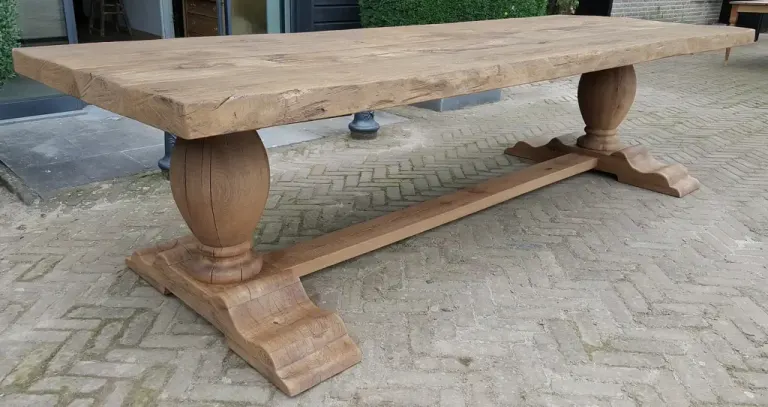
Live-Edge Book-Matched Dining Tables Paired slabs of Anatolian Juglans regia with preserved natural waney edges, brass/walnut butterfly keys, and sculptural blackened steel or solid walnut trestle bases \(220–360\text{ cm L} \times 95–120\text{ cm W} \times 4.0–5.5\text{ cm T}\) USA, UAE, Saudi Arabia, Switzerland, Germany
Mid-Century Modern Solid Walnut Coffee Tables 5-axis CNC-milled "shark-nose" underside bevels, tapered turned legs, organic biomorphic kidney/pebble silhouettes, and soft-close hidden drawers \(110–150\text{ cm L} \times 60–85\text{ cm W} \times 38–42\text{ cm H}\) UK, USA, France, Netherlands, Nordic countries
Synchronized Extension Walnut Dining Tables Continuous grain-matched staves across center butterfly leaves riding on heavy-duty German/Turkish aluminum ball-bearing slides \(180\text{ cm}\) closed \(\rightarrow 260–280\text{ cm}\) extended UK, Germany, Belgium, Canada
Mixed-Material Architectural Coffee Tables Solid American Black Walnut plinth bases paired with honed Denizli travertine, Calacatta Viola marble, or smoked bronze glass tops \(100–140\text{ cm}\) diameter or square modular nested sets UAE, Qatar, USA, France, Italy
Executive Conference & Boardroom Tables Multi-section solid walnut tops with integrated CNC-milled cable management troughs, leather inlay pads, and acoustic-damped bases \(360–600\text{ cm L} \times 130–160\text{ cm W}\) Saudi Arabia, Iraq, UK, Kazakhstan, Azerbaijan
5. Global Export Dynamics, Tariff Frameworks, and Market Trajectory
Türkiye’s strategic proximity to Europe, the Middle East, and North America underpins the commercial success of Mastering Solid Walnut Wood Tables and Coffee Tables in Turkey: Timber Imports, Artisan Joinery, and Global Export Strategy. Leveraging data from the Turkish Exporters Assembly (TİM) and sector federations, Turkish solid walnut table exports benefit from several structural trade advantages:
Key Destination Markets & Growth Drivers
1. United States: As American importers diversify supply chains away from East Asia amid tariff volatility, Türkiye has emerged as a high-craftsmanship near-shore alternative. By importing FAS American Black Walnut from U.S. sawmills under the duty-free DİR regime, transforming it into finished designer dining and coffee tables in Istanbul or İzmir, and shipping directly to New York, Savannah, or Houston ports in 16 to 22 days, Turkish manufacturers deliver authentic American walnut furniture with superior hand-finishing at highly competitive landed costs.
2. European Union (Germany, France, Netherlands, Romania, Bulgaria): Under the EU-Türkiye Customs Union, finished solid walnut tables exported under HS 9403.60.10 enter all 27 EU member states at 0% import duty when accompanied by an A.TR Movement Certificate. European retail buyers value Türkiye’s ability to execute low-to-medium Minimum Order Quantities (MOQs of 15–30 units per SKU) with 4-to-6-week production lead times.
3. United Kingdom: Protected by the UK-Türkiye Free Trade Agreement (EUR.1 Movement Certificate, 0% tariff), the UK remains one of Türkiye’s top three furniture destinations overall, with strong architectural demand for solid walnut extendable dining tables and nested coffee table sets.
4. Gulf Cooperation Council (Saudi Arabia, UAE, Qatar) & Iraq: Iraq continues as Türkiye’s largest overall furniture export partner, while Saudi Arabia’s luxury hospitality and residential mega-developments (recording over 200% sectoral export growth in 2025) drive intense demand for oversized, heirloom-grade Turkish and American walnut dining and majlis coffee tables.
6. Regulatory Compliance: EUDR, CITES, and Mechanical Testing Standards
Navigating international regulatory frameworks is essential for risk-free B2B trade in Mastering Solid Walnut Wood Tables and Coffee Tables in Turkey: Timber Imports, Artisan Joinery, and Global Export Strategy.
EU Deforestation Regulation (EUDR) & Timber Traceability
Under Regulation (EU) 2023/1115, solid walnut tables placed on the EU market (HS 9403) require verifiable due diligence proving the timber was harvested legally and without deforestation after December 31, 2020:
• For Imported American Black Walnut (Juglans nigra): Turkish exporters collect geolocated harvest plot polygons, state felling documentation, and phytosanitary certificates from their U.S. hardwood suppliers, linking each container bill of lading to the finished table batch ID in EU TRACES.
• For Domestic Anatolian Walnut (Juglans regia): Exporters retain official OGM transport permits (sevk pusulası), auction origin certificates, and cadastral parcel coordinates from the harvesting province in Türkiye.
• FSC & PEFC Chain-of-Custody: Leading Turkish factories hold active FSC Mix Credit or FSC 100% certifications, ensuring seamless compliance for institutional European and North American retail buyers.
CITES Verification
Neither Juglans nigra (American Black Walnut) nor Juglans regia (Turkish/European Walnut) is currently listed under CITES appendices (unlike Central/South American Juglans neotropica, which is CITES Appendix III). However, Turkish exporters routinely include botanical species declarations (Juglans nigra or Juglans regia) on commercial invoices to prevent customs holds by border inspection agencies.
Structural & Surface Durability Certifications
• EN 12521 & EN 15372: European mechanical safety, static load, and horizontal fatigue standards for domestic and non-domestic (contract) tables.
• CARB Phase 2 / EPA TSCA Title VI & EU REACH: Verification that any auxiliary substrates (such as concealed drawer bottoms) and all surface stains, sealers, and 2K polyurethane lacquers meet strict formaldehyde and heavy-metal emission limits.
7. Export Packaging Engineering & International Buyer Audit Protocol
Because solid walnut commands a high per-unit valuation, transit damage protection is paramount in Mastering Solid Walnut Wood Tables and Coffee Tables in Turkey: Timber Imports, Artisan Joinery, and Global Export Strategy:
1. Moisture-Equilibrium Packaging: Finished walnut tabletops are sealed inside 150-micron vapor-barrier polyethylene bags with integrated silica gel desiccants to prevent moisture absorption during sea transit.
2. ISTA 3A Drop-Tested Crating: Heavy solid walnut dining tables (often weighing \(65\text{ kg}\) to \(120\text{ kg}\)) are packed in 5-ply double-wall BC-flute export cartons reinforced with high-density EPE foam edge profiles, corner bumpers, and—for LCL (Less-than-Container-Load) or high-value single slabs—ISPM-15 heat-treated fumigated plywood crates.
3. Container Optimization: Utilizing knock-down (KD) leg assemblies with precision steel mounting plates allows 130 to 165 solid walnut dining tables or 350 to 450 solid walnut coffee tables to load efficiently into a single 40-foot High Cube container.
Five-Point Quality Control Checklist for Global Importers
Before releasing final balance payments on Turkish solid walnut table orders, procurement teams should verify:
• Botanical & Origin Verification: Cross-check timber purchase invoices and OGM/NHLA certificates to confirm genuine Juglans nigra or Juglans regia—never stained beech, ash, or acacia marketed as "walnut finish."
• Core Moisture Content Audit: Measure at least 10% of tabletops per batch with a calibrated pin meter to confirm \(6\%–8.5\%\) MC aligned with destination climate.
• Sapwood & Stave Matching Tolerance: Inspect finished tops under 5000K daylight LED illumination to verify adherence to agreed sapwood limits and grain continuity.
• Underside C-Channel & Threaded Insert Torque Check: Verify flush routing of anti-warp steel channels and proper perpendicular installation of metric steel inserts.
• 2K Lacquer / Hardwax Oil Adhesion Test: Perform cross-hatch adhesion verification (ISO 2409) on sample offcuts to guarantee long-term coating durability.