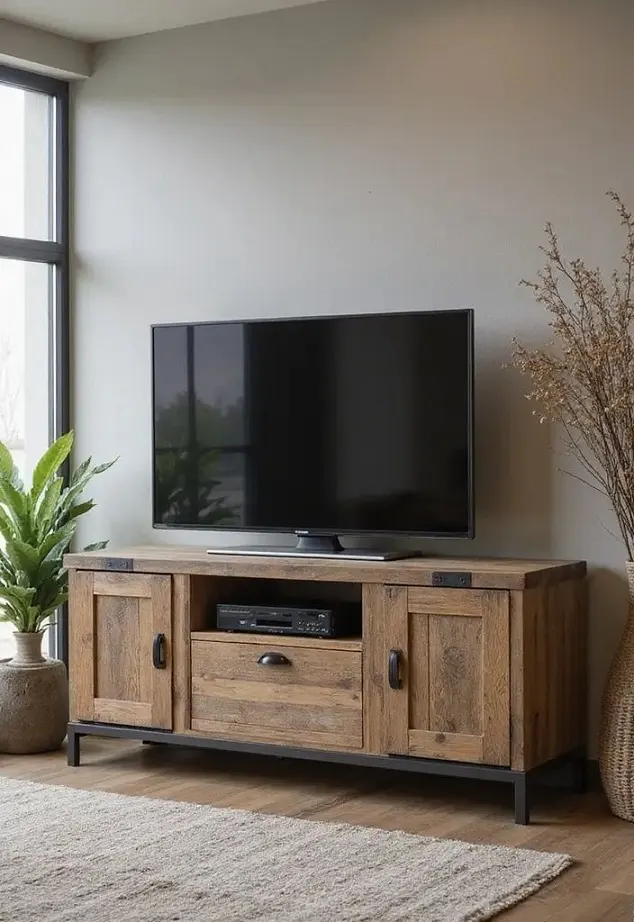
Mastering Export Logistics and Container Physics: Warehousing, Multi-Factory Consolidation, and Anti-Condensation Protocols for Aged and Distressed Solid Wood TV Units in Türkiye
In international solid wood furniture commerce, operational excellence on the woodworking floor means very little if a container of high-value weathered media consoles arrives at Rotterdam, Felixstowe, New York, or Jebel Ali with crushed carton corners, softened corrugated board, or moisture-induced wood cupping.
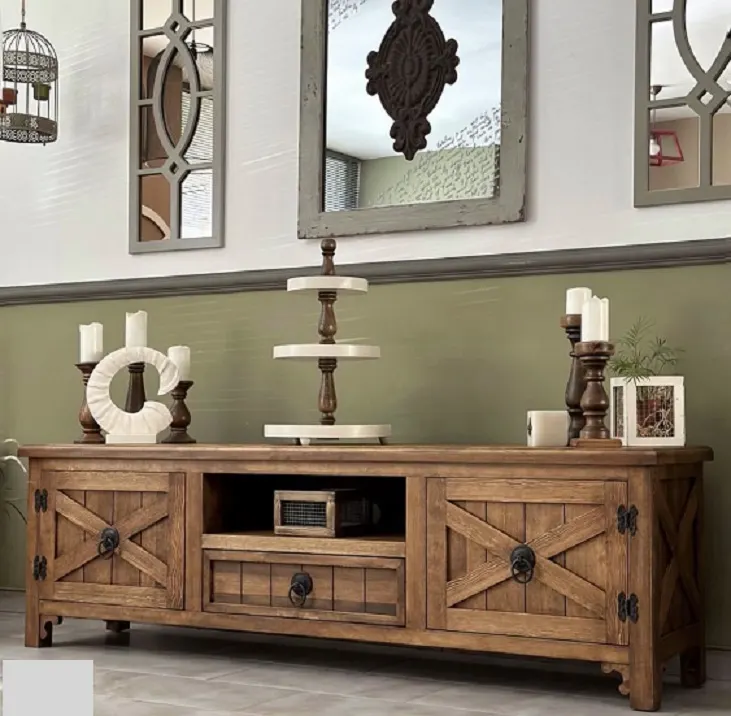
Because solid wood TV units with an aged and distressed look in Türkiye are heavy, hygroscopic, and frequently sourced across multiple specialized regional clusters—such as pairing hand-distressed Anatolian walnut consoles from Ankara’s Siteler district with wire-brushed Wildeiche (wild oak) units from İnegöl (Bursa) and forged-steel bases from Istanbul—orchestrating consolidation, container loading geometry, and maritime micro-climate protection is a decisive competitive skill. Mastering Export Logistics and Container Physics: Warehousing, Multi-Factory Consolidation, and Anti-Condensation Protocols for Aged and Distressed Solid Wood TV Units in Türkiye provides an authoritative, field-tested manual for supply chain directors, freight forwarders, furniture importers, and Turkish export managers executing container-scale and overland TIR shipments.
Türkiye’s geographic position bridging Europe, Asia, and the Middle East offers unmatched multimodal flexibility: 4-to-7-day overland curtain-sided mega-trailer corridors into Central Europe, Ro-Ro ferry links across the Mediterranean to Trieste and Sète, and deep-water container terminals in Gemlik, Ambarlı, Evyap/Yarımca, İzmir Aliağa, and Mersin. Yet each transport mode subjects kiln-dried, wire-brushed, and hand-patinated solid hardwood furniture to distinct mechanical vibration profiles, temperature swings, and relative humidity spikes.
Throughout Mastering Export Logistics and Container Physics: Warehousing, Multi-Factory Consolidation, and Anti-Condensation Protocols for Aged and Distressed Solid Wood TV Units in Türkiye, we dissect the complete post-production logistics chain—covering multi-cluster consolidation hub workflows in Istanbul and Bursa, volumetric container stuffing algorithms for 40-foot High Cube (40'HC) and 45'PW containers, thermodynamic prevention of "container rain" condensation, ISPM-15 solid wood dunnage compliance, sea-route versus overland TIR freight economics, and destination 3PL cross-docking protocols.
1. Multi-Cluster Consolidation Architecture: Uniting Ankara, İnegöl, and Istanbul Shipments
One of the defining operational advantages of sourcing aged and distressed solid wood TV units in Türkiye is the ability to curate a rich, multi-aesthetic product assortment across different Turkish manufacturing hubs without paying punitive Less-than-Container-Load (LCL) freight rates.
Why LCL Shipping Destroys Solid Wood Furniture Margins
Shipping heavy, bulky solid wood TV units via standard LCL ocean consolidation exposes cartons to repeated forklift transfers at origin CFS (Container Freight Station) warehouses, transshipment hubs, and destination deconsolidation terminals—driving transit damage rates above 8%–12% and inflating per-cubic-meter freight costs by 40%–65%. Under Mastering Export Logistics and Container Physics: Warehousing, Multi-Factory Consolidation, and Anti-Condensation Protocols for Aged and Distressed Solid Wood TV Units in Türkiye, experienced importers instead execute Buyer’s Consolidation Full Container Loads (FCL) via dedicated Turkish furniture logistics hubs:
1. Marmara Consolidation Corridor (Bursa / Gemlik & Istanbul):
• Workflow: Hand-crafted, antique-glazed walnut consoles manufactured in Ankara’s Siteler district are dispatched via dedicated domestic box trucks along the O-4/O-5 highway (approx. 4.5 hours) to a bonded or customs-cleared consolidation warehouse in İnegöl or Istanbul (Tuzla / Hadımköy). There, they are merged with wire-brushed Wildeiche oak TV units from İnegöl factories and mixed-material metal/stone consoles from Istanbul studios into a single 40-foot High Cube (40'HC) container or 100 CBM TIR mega-trailer.
• Documentary Synchronization: Rather than issuing fragmented export declarations, a Turkish Foreign Trade Capital Company (Sektörel Dış Ticaret Şirketi) or licensed customs broker consolidates line items under unified HS Code 9403.60 commercial invoices, packing lists, a single A.TR Movement Certificate (for EU entry), and a unified EUDR Due Diligence Statement (DDS) / GeoJSON polygon packet.
2. Aegean & Mediterranean Consolidation Corridor (İzmir & Mersin):
• Workflow: Exports originating from Kayseri’s large-scale industrial plants and southern Anatolian workshops consolidate at Mersin International Port for Middle Eastern, Red Sea, and North American sailings, while Aegean factories consolidate at İzmir Aliağa for direct transatlantic mother-vessel departures.
2. Export Warehousing Standards: Micro-Climate Control Before Container Gate-In
A critical vulnerability in Mastering Export Logistics and Container Physics: Warehousing, Multi-Factory Consolidation, and Anti-Condensation Protocols for Aged and Distressed Solid Wood TV Units in Türkiye occurs during the 5-to-14-day buffer window when finished, packed consoles await vessel loading or multi-vendor consolidation.
Preventing Moisture Regain in Packed Solid Timber
Solid oak, chestnut, and walnut TV units leave Turkish finishing lines calibrated strictly to 8.0%–10.0% Moisture Content (MC) (or 6.0%–8.0% MC for Gulf Cooperation Council destinations). If packed cartons are staged inside an uninsulated, damp port warehouse during rainy winter months in Marmara or Izmir, corrugated cardboard absorbs ambient humidity and transfers moisture vapor directly into the wood—causing wide tabletops to swell and cup before the ship even sails.
• Warehouse Hygrometer & Floor Elevation Rules: Consolidation warehouses must maintain indoor relative humidity between 45% and 55% RH, store all cartons elevated on ISPM-15 heat-treated wooden pallets (never directly on bare concrete floors, which wick ground moisture), and verify wood moisture via pinless dielectric hygrometers prior to container stuffing.
• Barcode WMS & Carton Labeling Accuracy: Every outer ECT-44 double-wall carton must display crisp, scannable GS1-128 / UPC barcodes, SKU codes, finish patina batch IDs (e.g., Smoked Driftwood Oak — Lot #2026-11), gross/net weights in kilograms and pounds, directional "This Side Up" arrows, and maximum stacking load icons.
3. Container Stuffing Physics: Maximizing Volumetric Yield Without Carton Crushing
Solid wood TV units present a classic volume-constrained ("cubing out") logistics profile: a 40-foot High Cube container offers approximately 68.0 to 70.0 CBM of practical loadable space and a 26,500 kg payload limit, yet 120 packed SKD solid wood consoles weigh only 6,500 to 8,500 kg—leaving massive unused weight capacity while filling every cubic centimeter of volume.
Transport Equipment Type Internal Dimensions (L × W × H) Practical Loadable Volume Assembled 200 cm Console Yield Semi-Knock-Down (SKD) Console Yield Best Geographic Corridor
20-Foot Standard Dry Container (20'GP) 5.90 m × 2.35 m × 2.39 m ~28 – 30 CBM 34 – 40 units 48 – 56 units Boutique retail trial orders & small hospitality FF&E batches
40-Foot High Cube Container (40'HC) 12.03 m × 2.35 m × 2.69 m ~68 – 70 CBM 80 – 92 units 115 – 140 units Primary global maritime workhorse (North America, UK, GCC, Asia)
45-Foot Pallet-Wide High Cube (45'HCPW) 13.55 m × 2.44 m × 2.69 m ~78 – 80 CBM 95 – 108 units 135 – 160 units Short-sea European container feeders (Gemlik/Ambarlı to Rotterdam/Felixstowe)
European TIR Curtain-Sided Mega-Trailer 13.60 m × 2.48 m × 3.00 m ~95 – 100 CBM 115 – 130 units 160 – 185 units Direct overland road freight from Türkiye to Germany, France, Benelux, Austria
Four Golden Rules of Container Loading Geometry
To eliminate transit crushing and shifting across rough ocean swells, loading crews executing Mastering Export Logistics and Container Physics: Warehousing, Multi-Factory Consolidation, and Anti-Condensation Protocols for Aged and Distressed Solid Wood TV Units in Türkiye enforce four structural loading rules:
1. Floor-Loaded (Dead-Piled) vs. Palletized Stuffing:
For standard retail and e-commerce distribution, floor-loading cartons tightly brick-stacked wall-to-wall maximizes container cube utilization by 15% to 22% compared to wooden pallets (saving $35 to $55 per unit in ocean freight). Palletization is reserved strictly for LTL/hotel job-site deliveries requiring rapid forklift offloading.
2. Respecting Maximum Crush-Stack Orientation:
Never lay long solid wood TV unit cartons flat on their broad face if stacked six-high—horizontal tabletop spans lack vertical edge strength and bow under upper-tier weight. Always load cartons upright on their long narrow edge (where 5-ply ECT-44 vertical flutes provide maximum column compression strength), placing heavier 240 cm consoles on the bottom two tiers and lighter 140–160 cm consoles on the upper tier.
3. Zero-Void Dunnage & Inflatable Airbags:
Any lateral or longitudinal gap exceeding 5 cm between carton rows allows cargo to slam violently during vessel rolling or emergency truck braking. Stuffing supervisors insert kraft-paper inflatable dunnage airbags and ISPM-15 heat-treated wooden bracing frames across the rear door bulkhead to lock the entire load into a monolithic block.
4. Heavy Stone-Top Isolation:
When shipping mixed-material distressed consoles featuring honed Afyon Marble or Denizli Travertine tops, marble slabs must be packed vertically on edge inside independent foam-lined plywood crates positioned strictly on the container floor tier—never stacked atop wooden cabinet cartons.
4. Thermodynamics of "Container Rain": Preventing Moisture Condensation During Sea Transit
Perhaps the single most overlooked technical hazard in maritime timber furniture export is "container rain"—a thermodynamic phenomenon that occurs when a container stuffed in mild Mediterranean conditions transits colder North Atlantic or Northern European waters (or vice versa).
How Condensation Forms Inside Sealed Steel Containers
Air inside a sealed steel container holds water vapor drawn from the container’s wooden floor, corrugated cardboard cartons, and ambient air at loading. When outside ocean temperatures drop sharply at night, the container’s corrugated steel roof cools rapidly below the internal dew point temperature. Moisture condenses into liquid droplets on the ceiling, raining down onto top-tier cartons, dissolving box glues, staining wire-brushed oak finishes, and triggering mold blooms.
Five-Step Anti-Condensation Defense Protocol
1. Pre-Stuffing Container Inspection & Floor Hygrometer Check:
Reject any shipping container exhibiting roof pinholes (verified via internal dark-room light-leak inspection), torn door rubber gaskets, oil odors, or wooden floor moisture content exceeding 14.0% MC.
2. Desiccant Pole Calculation & Placement:
Hang high-absorption calcium chloride + starch gel desiccant poles (each absorbing up to 2.0–2.5 liters of water without dripping) inside the recessed corrugations of the container side walls—deploying a minimum of 8 to 10 poles (1.5 kg–2.0 kg each) per 40'HC container, and 12 poles during winter sailings (November through March).
3. Kraft Moisture-Barrier Ceiling & Wall Liners:
Line the container ceiling and upper side walls with breathable, absorbent virgin kraft paper sheets or adhesive moisture-trap blankets so any trace ceiling condensation is absorbed before dripping onto cartons.
4. Sealed Silica Gel Sachets Inside Cartons:
Place two 50-gram Tyvek-wrapped silica gel packets inside each TV unit carton (taped away from direct contact with bare hardwax-oiled wood) to stabilize internal carton micro-humidity.
5. Vent Tape Sealing (Container Vent Control):
Seal standard container breather vents from the outside with heavy-duty waterproof tape once desiccant poles are hung, preventing humid salt-laden sea air from continuously entering and saturating the desiccants.
5. Multimodal Corridor Economics: Overland TIR Mega-Trailers vs. Short-Sea Feeders vs. Deep-Sea FCL
Choosing the optimal transport corridor under Mastering Export Logistics and Container Physics: Warehousing, Multi-Factory Consolidation, and Anti-Condensation Protocols for Aged and Distressed Solid Wood TV Units in Türkiye depends on destination geography, urgency, and unit landed-cost targets:
• Overland TIR Road Freight (Bursa/Istanbul → Germany, Austria, France, Benelux, UK):
• Transit Velocity: 4 to 6 days to Munich/Frankfurt/Rotterdam; 7 to 9 days to London/Midlands via Kapıkule (Bulgaria) or İpsala (Greece) border crossings.
• Economic Advantage: Mega-trailers carry 95 to 100 CBM (nearly 40% more volume than a 40'HC container) with air-ride suspension that eliminates port crane drops—allowing brands to ship fully assembled distressed consoles with lighter protective packaging and zero demurrage risk.
• Intermodal Ro-Ro + Rail Corridor (Pendik/Ambarlı/Alsancak → Trieste/Sète → Central Europe):
• Transit Velocity: 6 to 9 days door-to-door.
• Economic Advantage: Bypasses Balkan highway border queues and EU road-permit quotas by loading Turkish trailers onto Ro-Ro ferries bound for Trieste (Italy) or Sète (France), connecting directly onto European rail block-trains into Germany, Benelux, and the UK while cutting Scope 3 transport carbon emissions by 45%.
• Deep-Sea Container Shipping (Gemlik/Ambarlı/İzmir/Mersin → North America, GCC, Asia-Pacific):
• Transit Velocity: 5 to 9 days to Jebel Ali/Dammam/Jeddah; 16 to 22 days to New York/Savannah/Norfolk; 28 to 34 days to Los Angeles/Oakland.
• Contracting Tip: Negotiate 14 to 21 days of combined destination detention and demurrage free time upfront in carrier service contracts and utilize Telex Release / Sea Waybills so customs clearance begins days before vessel berthing.
6. Destination 3PL Cross-Docking, Pre-Delivery QC, and Reverse Logistics
The final link in Mastering Export Logistics and Container Physics: Warehousing, Multi-Factory Consolidation, and Anti-Condensation Protocols for Aged and Distressed Solid Wood TV Units in Türkiye occurs when containers reach destination 3PL distribution centers in New Jersey, Savannah, Rotterdam, or Coventry:
1. Container Devannning & Moisture Spot-Check: 3PL receiving teams photograph seal integrity upon door opening, inspect top-tier cartons for moisture, and perform a 5% random barcode and hygrometer check before shelving SKUs.
2. Pre-Delivery Touch-Up & White-Glove Prep: For luxury retail and hospitality shipments, keeping a small stock of Turkish factory-supplied color-matched touch-up wax sticks and Rubio Monocoat maintenance oil vials at the destination 3PL enables technicians to resolve minor handling scuffs locally in minutes rather than shipping damaged consoles back across oceans.
Conclusion: Engineering End-to-End Supply Chain Reliability From Türkiye to the World
As demonstrated throughout Mastering Export Logistics and Container Physics: Warehousing, Multi-Factory Consolidation, and Anti-Condensation Protocols for Aged and Distressed Solid Wood TV Units in Türkiye, mastering physical logistics is just as critical to furniture profitability as kiln-drying and patina craftsmanship. By consolidating multi-cluster production from Ankara, İnegöl, and Istanbul into dead-piled 40'HC containers or 100 CBM TIR mega-trailers, enforcing strict container-floor hygrometer checks and calcium chloride desiccant protocols, and matching transport modes to regional velocity targets, importers and Turkish exporters can deliver weathered solid wood TV units across global markets with near-zero transit damage and superior landed-cost margins.