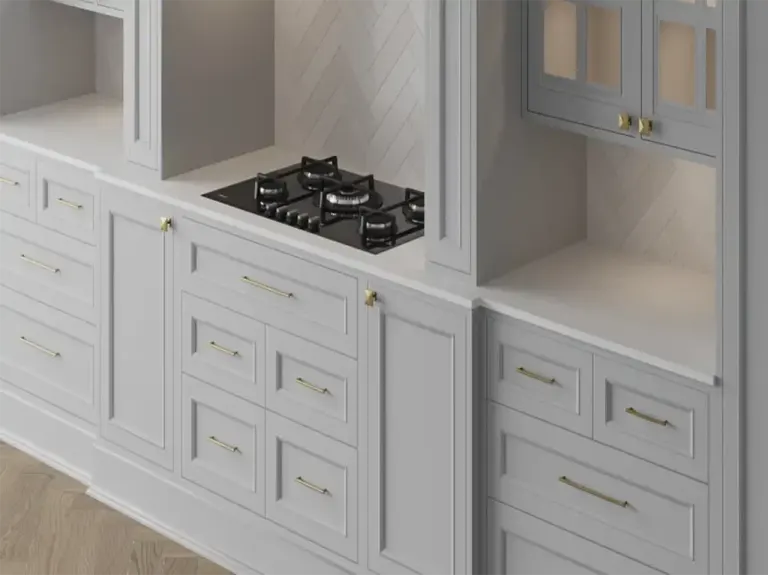
Kitchen Cabinets: The Complete Technical Guide to Manufacturing, Materials, Export Standards, and Sourcing in 2026
Kitchen Cabinets Turkey has transitioned from a regional carpentry trade into one of Eurasia’s most technologically advanced modular furniture manufacturing powerhouses. Driven by strategic proximity to European, Middle Eastern, and Central Asian markets, combined with massive capital investments in German and Italian CNC automation, Turkish cabinetry manufacturers now rival traditional European leaders in precision, material durability, and cost-efficiency.
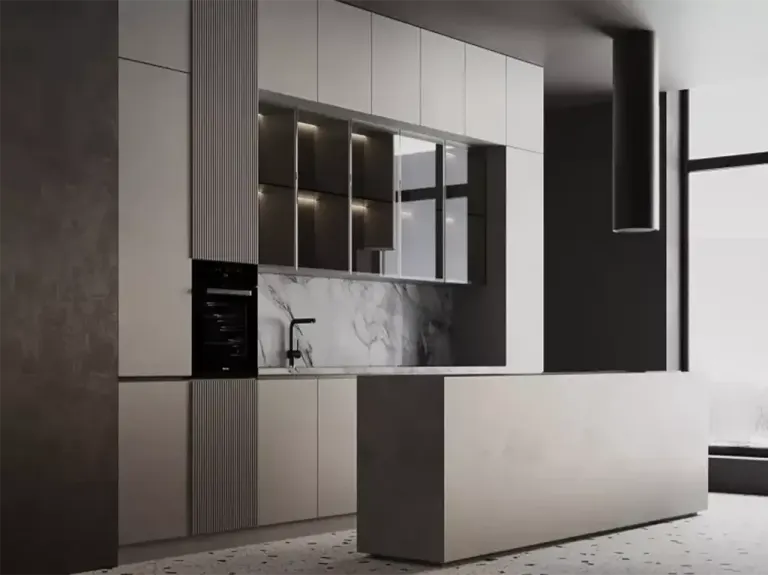
Whether you are an international B2B procurement manager, an architectural specifier, a real estate developer, or a homeowner renovating a property in Istanbul, Izmir, or Ankara, navigating the Kitchen Cabinets Turkey ecosystem requires a deep understanding of wood-based panel engineering, European hardware integration, moisture-resistance classifications, and international logistics protocols.
1. The Architectural and Industrial Landscape of Kitchen Cabinets Turkey
The modern Kitchen Cabinets Turkey industry is anchored by vertically integrated industrial zones. Unlike fragmented markets where workshops rely on third-party board cutting, major Turkish producers operate automated factories spanning 20,000 to 100,000 square meters.
Primary Manufacturing Hubs in Türkiye
• İnegöl (Bursa): Widely recognized as the furniture capital of Türkiye, İnegöl hosts hundreds of specialized cabinetry manufacturers, raw board suppliers, and hardware distributors, creating an unmatched supply chain cluster.
• Kayseri: Home to some of the largest industrial furniture conglomerates in the Mediterranean basin, specializing in high-volume, flat-pack modular kitchen systems designed for global export.
• Istanbul (Masko, Modoko, and Tuzla/Gebze Industrial Zones): The epicenter for bespoke architectural joinery, luxury villa kitchens, and high-end showroom retail, catering to both domestic luxury real estate and international architectural firms.
• Ankara (Siteler): A historic powerhouse for custom woodworking, solid wood craftsmanship, and institutional cabinetry projects.
• Izmir (Karabağlar and Kemalpaşa): A strategic coastal hub optimized for maritime container exports to North America, the UK, and Southern Europe, specializing in modern lacquer and acrylic finishes.
Vertical Integration: The Raw Material Advantage
A critical competitive edge for Kitchen Cabinets Turkey is domestic access to world-class wood-based panels. Türkiye is one of Europe's largest producers of MDF (Medium-Density Fiberboard) and particleboard (chipboard), led by global industrial giants headquartered locally, such as Kastamonu Entegre, Yıldız Entegre, and Çamsan. Because cabinet manufacturers source raw boards directly from domestic mills within a 200-kilometer radius, lead times are compressed and raw material costs remain insulated from severe import tariffs.
2. Core Carcass Engineering: Structural Integrity and Substrate Standards
The longevity of any kitchen installation depends entirely on the carcass (cabinet box) engineering. In the Kitchen Cabinets Turkey manufacturing sector, carcass construction adheres strictly to European EN standards, though specifications vary significantly between economy builder-grade units and architectural-grade cabinetry.
Substrate Comparison: Chipboard vs. Standard MDF vs. HMR MDF
Technical Parameter Melamine-Faced Chipboard (Yonga Levha) Standard MDF (Medium-Density Fiberboard) High Moisture Resistant (HMR) MDF Marine Plywood (Su Kontrası)
Density (kg/m³) 620 - 680 kg/m³ 720 - 780 kg/m³ 750 - 820 kg/m³ 650 - 750 kg/m³
Standard Thickness 18 mm 18 mm 18 mm 18 mm
Screw-Holding Capacity Moderate (requires coarse Euro screws) High (uniform fiber matrix) Very High Exceptional
24-Hour Swelling Rate 12% - 15% 10% - 12% < 6% (Green core) < 3% (Phenolic glue)
Typical Turkish Application Standard dry-zone upper/lower carcasses Routed fronts, painted carcasses Sink bases, dishwasher housings, coastal homes Luxury bespoke projects, outdoor kitchens
The 18 mm Standard vs. 16 mm Export Cuts
While many North American and budget European manufacturers utilize 15 mm or 16 mm panels to reduce weight and material expenditure, the domestic standard across Kitchen Cabinets Turkey is 18 mm thickness for both carcasses and shelving. This extra 2 mm provides superior deflection resistance across wide spans (such as 90 cm or 100 cm base cabinets) and ensures deeper engagement for concealed hinge mounting plates.
Back Panel Construction Protocols
Low-tier cabinetry often relies on 3 mm HDF (High-Density Fiberboard) stapled directly to the rear edges, which compromises racking resistance during transport and installation. High-specification Kitchen Cabinets Turkey producers utilize:
• 8 mm Melamine-Faced MDF Back Panels: Inserted into precision CNC-milled grooves (10 mm to 12 mm inset from the rear edge).
• Full-Frameless Structural Backs: Providing complete diagonal rigidity and allowing heavy wall cabinets to be suspended safely using concealed heavy-duty hanging brackets (capable of supporting 65 kg to 130 kg per pair).
3. Surface Technologies and Front Door Finishes
The aesthetic appeal and surface durability of Kitchen Cabinets Turkey are defined by advanced pressing, coating, and edge-banding technologies. Turkish factories deploy automated Homag, Biesse, and SCM processing lines to execute complex front profiles.
1. Polyurethane and Acrylic Lacquer (Lake Kapak)
Lacquer remains the gold standard for luxury Kitchen Cabinets Turkey designs, particularly in neoclassical shaker profiles and minimalist handleless (Gola) kitchens.
• Substrate: High-density (780 kg/m³) E1-certified raw MDF.
• Process: Multi-stage CNC routing, automated orbital sanding, application of two coats of high-build polyester/polyurethane primer, intermediate sanding, and two topcoats of UV-stabilized Italian or German polyurethane paint (e.g., Sayerlack, Renner, ICA).
• Finish Options: Super-matte (3 - 5 gloss units), satin (20 - 30 gloss units), and mirror high-gloss (90+ gloss units).
2. High-Gloss and Super-Matte Acrylic Panels
Acrylic fronts are engineered by laminating a 0.8 mm to 1.5 mm thick sheet of pure PMMA (Polymethyl Methacrylate) onto an 18 mm MDF core using PUR (Polyurethane Reactive) hot-melt adhesives.
• Scratch Resistance: Premium Turkish acrylic panels feature a hard-coat top layer rated up to 2H - 4H pencil hardness.
• Anti-Fingerprint (AFP) Technology: Super-matte acrylics utilize electron-beam curing or excimer laser matting to create a micro-textured surface that prevents sebum adhesion and resists micro-scratches.
3. Thermofoil / Membrane Press (Membran Kapak)
Membrane doors are produced by vacuum-pressing flexible PVC or PET foils over CNC-carved MDF doors under heat and pressure.
• Advantage: Seamless wrapping around beveled edges and recessed shaker panels without edge-banding seams, offering strong moisture protection at a mid-range price point.
• Heat Shielding: Quality producers in Kitchen Cabinets Turkey mandate the installation of aluminum heat-deflector strips on cabinets flanking built-in ovens to prevent thermal delamination of the PVC foil.
4. Synchronized Embossed-in-Register (EIR) Melamine
Modern Turkish melamine panels (such as Kastamonu Entegre’s Artprint or Yıldız Entegre’s Varioclic series) replicate natural oak, walnut, and travertine stone. Through EIR pressing, the physical woodgrain texture aligns precisely with the printed visual grain, offering high impact resistance and UV stability for high-traffic commercial and residential developments.
5. Natural Wood Veneer and Solid Timber
For bespoke architectural builds, artisans apply 0.6 mm to 1.5 mm book-matched natural walnut, white oak, or ash veneers over MDF cores, finished with open-pore matte acrylic sealers that preserve the tactile warmth of natural timber while preventing seasonal warping.
4. Edge-Banding Engineering: The PUR and Laser Advantage
In humid culinary environments, edge-banding is the primary line of defense against moisture ingress and delamination.
• EVA (Ethylene-Vinyl Acetate) Gluing: Used primarily in budget-tier cabinetry. EVA melts at lower temperatures (180°C - 200°C) and can soften if exposed to intense steam from dishwashers or kettles.
• PUR (Polyurethane Reactive) Edge-Banding: The benchmark for reputable Kitchen Cabinets Turkey manufacturers. PUR undergoes an irreversible chemical cross-linking reaction upon exposure to ambient moisture, creating a waterproof, heat-resistant bond (withstanding -30°C to +150°C) with a near-invisible glue line (0.05 mm).
• Zero-Joint Laser / Hot-Air Edge-Banding: Deployed in top-tier Turkish facilities, this process melts a functional polymer layer directly on the reverse side of the ABS/PP edge band, fusing it molecularly to the board with zero adhesive line.
5. Hardware, Motion Systems, and Ergonomic Integration
A defining characteristic of the Kitchen Cabinets Turkey export sector is its seamless integration of world-leading European motion hardware alongside high-value domestic alternatives.
Global Tier-1 Hardware Partners
Virtually all mid-to-high-end Turkish kitchen manufacturers maintain direct OEM accounts with:
• Blum (Austria): Clip top Blumotion soft-close hinges, Tandembox Antaro and Legrabox slim-walled drawer systems, and Aventos bi-fold/parallel lift systems for wall units.
• Hettich (Germany): Sensys integrated soft-close hinges and InnoTech Atira / ArciTech double-walled steel drawer runners.
• Grass (Austria) & Häfele (Germany): Concealed undermount slides, corner pull-out mechanisms (Magic Corner, LeMans trays), and integrated LED profile lighting.
Domestic Turkish Hardware Ecosystems
For cost-sensitive mass-housing projects, Turkish hardware manufacturers such as Samet and Yeniler produce internationally certified (LGA/TÜV) soft-close hinges, telescopic ball-bearing slides, and tandem drawer boxes that offer 80% - 90% of the mechanical lifecycle performance of Austrian counterparts at a 30% - 40% lower hardware cost.
6. Environmental Compliance, Certifications, and Quality Control
To export Kitchen Cabinets Turkey units into the European Union, the United Kingdom, and North America, factories must comply with stringent chemical emission and structural safety regulations.
1. Formaldehyde Emission Standards (E1, E0, and CARB Phase 2 / TSCA Title VI):
• All reputable Turkish panel manufacturers produce E1-certified boards (≤ 0.1 ppm formaldehyde release) as a baseline.
• For exports to the United States and Canada, Turkish cabinetry producers utilize CARB Phase 2 / EPA TSCA Title VI compliant MDF and particleboard, ensuring strict adherence to ultra-low emission thresholds.
2. FSC and PEFC Chain of Custody:
• Sustainable forestry certifications are widely maintained by leading Turkish board mills and export-oriented cabinet factories to satisfy green building standards (LEED and BREEAM) for commercial developments.
3. ISO 9001 & TSE Standards:
• Domestic quality is regulated by the Turkish Standards Institution (TSE), specifically TS EN 14749 (Domestic and kitchen storage units and worktops — Safety requirements and test methods).
7. Modular Sizing Standards: European Metric vs. North American Imperial
When sourcing Kitchen Cabinets Turkey, international buyers must align dimensional conventions during the CAD/CAM engineering phase.
Standard Turkish / European Metric Specifications
• Base Cabinet Carcass Height: 720 mm or 780 mm (excluding plinth).
• Plinth (Toe-Kick) Height: 100 mm to 150 mm adjustable PVC legs with aluminum-clad or matching PVC plinth boards.
• Base Cabinet Depth: 560 mm carcass depth (600 mm total depth with 18 mm door and 22 mm countertop overhang).
• Wall Cabinet Heights: 360 mm, 600 mm, 720 mm, 900 mm, or full-ceiling 1080 mm.
• Wall Cabinet Depth: 320 mm to 350 mm carcass depth.
• Standard Module Widths: Multiples of 150 mm (150, 300, 450, 600, 750, 900, 1200 mm) plus 400 mm, 500 mm, 800 mm, and 1000 mm.
Customization for North American Projects
Unlike European frameless (32mm system) cabinetry, North American residential projects often specify face-frame construction or deeper imperial dimensions (24 inches / 610 mm base depth; 34.5 inches / 876 mm base height). Leading Kitchen Cabinets Turkey export factories maintain dedicated CNC programming libraries capable of manufacturing both European Frameless (Full Access) and American Face-Frame cabinetry to exact millimeter tolerances.
8. Countertop Pairing and Ergonomic Work Triangle Design
While cabinetry forms the structural core, Turkish kitchen suppliers frequently bundle quartz, porcelain, and solid-surface countertops to provide turnkey container loads.
• Engineered Quartz: Türkiye is a major global producer of quartz surfaces, led by Çimstone and Belenco, which utilize Bretonstone technology to create non-porous, stain-resistant slabs in 15 mm and 20 mm thicknesses.
• Sintered Stone / Porcelain Slabs: Ultra-compact 12 mm porcelain surfaces (e.g., Lamar, Neolith, Dekton) are increasingly popular in modern Kitchen Cabinets Turkey designs for their extreme thermal shock resistance and seamless waterfall island edges.
• Ergonomic Clearance Rules:
• Countertop-to-Wall Cabinet Gap: Standard 550 mm to 600 mm clearance to accommodate countertop appliances and provide unobstructed sightlines.
• Island Aisle Width: Minimum 1050 mm to 1200 mm between parallel runs to allow full extension of opposing 500 mm drawers and dishwasher doors simultaneously.
9. B2B Procurement, Cost Dynamics, and International Logistics
Sourcing Kitchen Cabinets Turkey offers a compelling financial advantage: buyers typically achieve 30% to 50% cost savings compared to German or Italian cabinetry of equivalent hardware and board specification, alongside significantly faster transit times to Europe, the UK, and the US East Coast compared to East Asian suppliers.
Packaging Engineering: Flat-Pack (RTA) vs. Rigid Pre-Assembled
1. Flat-Pack / Ready-to-Assemble (RTA):
• Best For: Large-scale multi-unit residential towers, container optimization, and wholesale distribution.
• Container Capacity: A \(40\text{ft High Cube (40' HC)}\) shipping container holds approximately 18 to 25 complete flat-pack kitchens, depending on unit count and island sizes.
• Assembly Hardware: Precision CNC-drilled for Minifix cam-and-dowel systems and wooden dowels, ensuring square assembly on-site without visible exterior screw heads.
2. Rigid (Factory Pre-Assembled):
• Best For: Luxury custom villas, boutique hotels, and projects where on-site skilled carpentry labor is expensive or scarce.
• Container Capacity: A 40ft HC container accommodates 6 to 9 complete rigid kitchens, protected with high-density EPS foam corner guards, honeycomb cardboard sheathing, and stretch-wrap palletization.
Step-by-Step Procurement Workflow for International Buyers
1. Architectural DWG & BOQ Submission: Provide floor plans, elevation drawings, and appliance schedules (MEP plans) to the factory's technical engineering office.
2. 3D Shop Drawings & Material Sampling: Receive detailed module-by-module shop drawings (generated in Cabinet Vision, Imos, or Pytha) alongside physical sample boxes containing door swatches, edge-band profiles, and carcass cutaways.
3. Deposit & Raw Material Allocation: Standard commercial terms involve a 30% to 50% down payment via wire transfer or irrevocable Letter of Credit (LC), triggering board pressing and hardware procurement.
4. Production & Pre-Shipment Inspection (PSI): Production lead times typically span 3 to 5 weeks for modular melamine/acrylic orders and 5 to 7 weeks for custom multi-coat lacquer finishes. Third-party inspection agencies (SGS, Bureau Veritas, Intertek) or buyer representatives verify dimensional accuracy, moisture content, and packaging integrity prior to container loading.
5. Customs & Freight Forwarding: Goods ship EXW (Ex-Works), FOB (Free on Board — Ambarlı, Gemlik, or Aliağa ports), or CIF/DDP directly to destination ports. Under the EU-Türkiye Customs Union, Turkish-manufactured kitchen cabinets enter EU member states with zero customs duty (accompanied by an A.TR movement certificate).
10. Checklist for Auditing a Turkish Kitchen Cabinet Manufacturer
Before finalizing a contract in the Kitchen Cabinets Turkey market, verify the following technical indicators to distinguish true industrial manufacturers from small trading intermediaries:
• Machinery Park Verification: Confirm the presence of automated beam saws, nesting CNC routers, automatic contour edge-banders with PUR glue pots, and pressurized dust-free lacquer spray booths.
• Hardware Authenticity: Verify that hinges and drawer slides carry authentic laser-etched serial codes from Blum, Hettich, or Samet rather than unbranded lookalikes.
• Sink Base Protection: Ensure the bottom panel of the sink cabinet includes an aluminum water-shield tray or is constructed from green-core HMR MDF/marine plywood.
• Warranty Terms: Established Turkish factories provide 5- to 10-year structural warranties on carcasses and finishes, backed by lifetime mechanical warranties from their European hardware suppliers.