Floating Solid Wood TV Units: Cantilever Engineering, Wall-Load Mechanics, and Minimalist Living Room Design
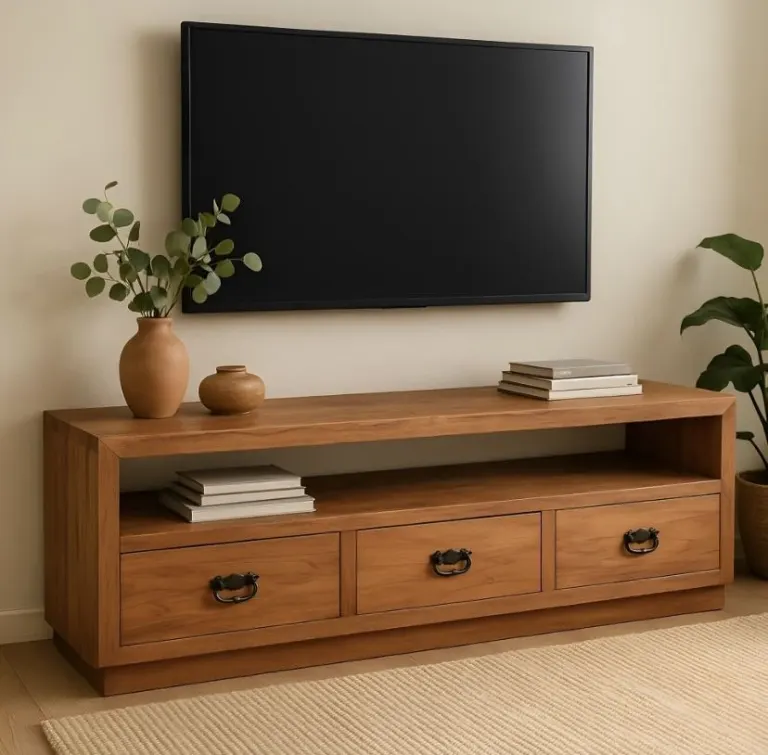
Installing floating solid wood TV units transforms a living room by lifting heavy cabinetry off the floor, exposing continuous hardwood or stone flooring, and establishing a clean architectural focal point beneath wall-mounted displays. Unlike lightweight melamine wall shelves or hollow particleboard boxes, floating solid wood TV units must manage substantial dead weight—often 45 kg to 95 kg of kiln-dried hardwood timber alone—alongside heavy audio-visual receivers, center-channel speakers, and dynamic downward forces. This technical guide details the structural wall-anchoring physics, torsion-box subframe engineering, hardwood selection, thermal airflow design, and ergonomic installation standards required to build and mount floating solid wood TV units safely and permanently.
1. The Physics of Cantilevered Cabinetry in Floating Solid Wood TV Units
When a media console is suspended from a vertical wall without floor legs, gravity creates two simultaneous mechanical forces at the wall-to-cabinet interface: vertical shear force (pulling the unit straight down along the wall plane) and cantilever bending moment (rotational torque pulling the top rear edge away from the wall while compressing the bottom rear edge into the drywall or plaster).
Understanding Bending Moments and Pull-Out Loads
In structural mechanics, the rotational torque (\(\tau \)) exerted on the upper wall fasteners increases proportionally with the cabinet's depth (\(d\)) and total loaded weight (\(W\)). Because floating solid wood TV units typically measure 40 cm to 48 cm (15.7 to 19 inches) deep to accommodate modern AV receivers, the outward pull-out force on the upper mounting rail is significantly higher than that of shallow wall bookshelves.
• Dynamic vs. Static Safety Factors: While a static load includes the solid hardwood cabinet, an AV receiver (15 kg), a center speaker (10 kg), and gaming consoles (8 kg), engineers apply a minimum 3x to 4x safety factor to account for accidental dynamic loads—such as a person leaning on the front edge of the console while dusting or plugging in cables.
• Why Televisions Should Be Wall-Mounted Separately: Even when anchored into structural studs, floating solid wood TV units should support audio-visual components and decor rather than carrying the concentrated pedestal weight of an 77-inch or 85-inch television. Mounting the display independently on an articulated wall bracket eliminates excessive front-edge torque on the console.
2. Timber Selection Matrix for Floating Solid Wood TV Units
Choosing the right hardwood species for floating solid wood TV units requires balancing high flexural stiffness (modulus of elasticity) with manageable specific gravity so the cabinet carcass does not become unnecessarily heavy before equipment is even loaded.
Hardwood Species Specific Gravity (12% MC) Janka Hardness (lbf) Modulus of Elasticity (GPa) T/R Shrinkage Ratio Suitability for Wall-Mounted Consoles
American Black Walnut (Juglans nigra) 0.55 1,010 11.6 1.4 (Benchmark stability) Ideal; high strength-to-weight ratio, minimal seasonal movement against rigid wall cleats
African Mahogany / Khaya (Khaya ivorensis) 0.50 830 – 1,070 9.6 1.4 (Very stable) Excellent; lightweight interlocked grain reduces dead wall load across 240+ cm spans
Quarter-Sawn White Oak (Quercus alba) 0.68 1,360 12.3 1.8 (Low distortion) High; exceptional span rigidity and dent resistance, requires heavy-duty stud anchoring
European Ash (Fraxinus excelsior) 0.60 1,320 12.0 1.7 (Moderate-Low) High; bright Scandinavian aesthetic with superior shock elasticity
Sweet Chestnut (Castanea sativa) 0.48 710 8.5 1.6 (Stable) Good; lightweight architectural timber with warm grain and natural tannin stability
Hard Sugar Maple (Acer saccharum) 0.63 1,450 12.6 2.0 (Requires strict kiln control) Moderate-High; dense and ultra-durable, demands strict 6%–8% kiln drying
Why Dimensional Stability Is Critical Against a Rigid Wall
Unlike freestanding consoles that sit freely on a floor, floating solid wood TV units are bolted rigidly to an immovable architectural wall. If the timber is not kiln-dried to an exact 6% to 8% moisture content (MC), seasonal expansion across the depth of the top slab can push outward against the wall or cause mitered corners to split. Selecting low-shrinkage species like American Black Walnut or Quarter-Sawn White Oak—assembled from narrow, alternating-growth-ring staves (70 mm to 100 mm wide)—keeps the carcass dimensionally stable year-round.
3. Structural Cabinet Engineering: Torsion Boxes and Internal Reinforcements
To prevent the front edge of floating solid wood TV units from drooping over 180 cm to 280 cm (71 to 110 inch) spans, master cabinetmakers build hidden structural frameworks directly into the carcass:
1. Concealed Torsion-Box Floor Subframe: Beneath the bottom deck of the cabinet, builders construct an internal grid of interlocking solid hardwood ribs (typically 25 mm × 50 mm) skinned top and bottom. This torsion box transfers downward bending forces from the front nose straight back to the wall-mounted ledger rail.
2. Reinforced 45-Degree Mitered Waterfall Corners: Minimalist floating solid wood TV units wrap continuous grain from the top slab down the vertical end panels. Artisans reinforce these long-grain miters with internal hardwood splines or loose tenons (Domino joinery) so the side panels act as structural shear webs supporting the front edge.
3. Full-Height Internal Dividers: Solid hardwood vertical partitions (22 mm to 28 mm thick) joined into the top and bottom decks via stopped dadoes or mortise-and-tenon joints tie the front of the top slab directly to the rear wall cleat, eliminating mid-span sag.
4. Heavy-Duty Rear Hanging Rail: Instead of attaching fasteners through thin plywood backing, builders rabbet a 25 mm to 32 mm thick solid hardwood mounting rail (or continuous 6 mm structural steel angle) flush into the upper rear carcass, secured to the side panels and vertical dividers with structural joinery.
4. Wall Mounting Systems and Substrate Anchoring Standards
Even the strongest cabinet engineering fails if the wall connection is compromised. Installing floating solid wood TV units safely depends entirely on the structural substrate behind your finished wall surface.
Mounting Hardware Comparison
• Interlocking Extruded Aluminum French Cleats (Z-Bars): Aircraft-grade 6061-T6 aluminum cleats spanning 85% to 90% of the cabinet width distribute shear and pull-out forces evenly across multiple wall studs while allowing micro-lateral adjustment during installation.
• Concealed Steel Cantilever L-Brackets: For ultra-slim or open-shelf floating solid wood TV units lacking tall back rails, 6 mm to 8 mm thick powder-coated steel L-brackets bolted directly to wall studs before drywall installation (or recessed into the wall framing) provide invisible support rated up to 150 kg per pair.
• Hardwood French Cleats (45-Degree Bevel): Traditional 25 mm thick Baltic birch or solid ash cleats work well for shorter spans (up to 150 cm) when paired with lower safety screws to prevent accidental upward lifting.
Substrate-Specific Fastener Protocols
• Wood-Stud Framing (North American Standard): Locate vertical timber studs (typically spaced 40 cm / 16 inches on center). Drive 8 mm (#14 or 5/16") structural washer-head lag screws at least 65 mm (2.5 inches) into the solid center of every available stud along the cleat—never rely on drywall toggle bolts alone for heavy solid wood consoles.
• Steel-Stud Framing (Commercial / High-Rise Apartments): Light-gauge 20-gauge metal studs lack pull-out strength for cantilevered cabinetry. Open the drywall to install 18 mm exterior-grade plywood or solid lumber blocking spanning across at least three steel studs, or use heavy-duty snap-toggle anchors (such as Toggler Snaptoggle) rated for 100+ kg each across dense multi-point grids.
• Solid Brick, Concrete, or Stone Masonry: Drill precision holes using a rotary hammer drill and install 10 mm (3/8") sleeve anchors, expansion wedge anchors, or two-part injectable epoxy anchors every 30 cm to 40 cm along the mounting rail.
5. Thermal Airflow, Acoustics, and In-Wall Cable Concealment
Because floating solid wood TV units leave the wall and floor beneath them completely visible, exposed power cords or hanging HDMI cables immediately ruin the minimalist architectural effect.
Zero-Wire In-Wall Routing Architecture
1. Recessed Power and Low-Voltage Boxes: Position a recessed duplex power outlet and a low-voltage brush pass-through plate directly behind the cabinet carcass—completely hidden inside the unit's interior footprint—and link it vertically inside the wall cavity to a second recessed outlet box behind the wall-mounted TV.
2. Scribed Rear Chase Cavity: Set the cabinet’s magnetic removable back panel 50 mm (2 inches) forward from the rear edge of the side panels. This hidden void houses surge protectors, bulky power bricks, and rigid HDMI 2.1 cables without pushing the console away from the wall.
Passive and Active Heat Dissipation
Modern AV receivers, stereo amplifiers, and gaming consoles generate 150W to 450W of continuous waste heat inside closed bays:
• Bottom-to-Top Chimney Convection: Route 40 mm (1.5 inch) cool-air intake slots into the hidden floor of each equipment bay and matching 40 mm warm-air exhaust slots along the upper rear deck so cool room air rises naturally across electronics.
• Whisper-Quiet Thermostatic Fans: For fully enclosed floating solid wood TV units housing Class A/B amplifiers, integrate ultra-quiet (<18 dBA) 120 mm PWM exhaust fans wired to a thermal probe set to activate at 32°C (90°F).
• IR & Acoustic Door Fronts: Specify vertical fluted hardwood slats spaced 8 mm to 12 mm apart backed with dark acoustic fabric—or hand-woven natural rattan cane inserts—so infrared remote controls and center-channel speakers function cleanly behind closed doors.
6. Ergonomic Mounting Heights and Visual Proportions
Determining the exact elevation on the wall is critical when installing floating solid wood TV units, as relocating wall anchors afterward requires drywall or masonry repair.
Floor Clearance and Screen Centerline Geometry
• Ideal Floor-to-Bottom Clearance: Mount the underside of the floating console 20 cm to 30 cm (8 to 12 inches) above the finished floor. This height keeps the cabinet visually grounded while allowing effortless sweeping, mopping, and robotic vacuum passage underneath.
• Seated Eye-Level Alignment: Adult eye level on a standard sofa sits 100 cm to 108 cm (39 to 42.5 inches) above the floor. With a console height of 35 cm to 42 cm (14 to 16.5 inches) mounted 25 cm off the floor, the top surface sits at roughly 60 cm to 67 cm (23.5 to 26.5 inches)—leaving an ideal 12 cm to 18 cm (5 to 7 inch) breathing gap below a wall-mounted 65-inch or 77-inch television centered at eye level.
• Lateral Visual Anchoring: Extend floating solid wood TV units at least 20 cm to 35 cm (8 to 14 inches) wider than the television screen on each side to establish balanced architectural symmetry.
7. Finishes, Hardware, and Long-Term Care Protocol
• Zero-VOC Penetrating Hardwax Oils: Molecularly bond with surface wood fibers, preserving the tactile open-pore texture of walnut or white oak while allowing seamless local spot-repairs without unmounting the cabinet from the wall.
• 2K Waterborne Dead-Flat Polyurethane (5° Sheen): Delivers commercial-grade spill, heat, and scratch protection with a natural, non-yellowing matte appearance.
• Precision Concealed Hardware: Pair three-way adjustable European soft-close hinges (Blum CLIP top BLUMOTION) with 45 kg (100 lbs) undermount tandem drawer runners and magnetic touch-latches for clean, handle-free minimalist elevations.
• Seasonal Maintenance: Maintain indoor relative humidity between 35% and 55%, apply 3 mm wool felt pads beneath heavy AV equipment, and dust weekly along the grain with a barely damp microfiber cloth followed immediately by a dry towel.
If you are planning or installing floating solid wood TV units, share a few details about your room and I can help specify mounting hardware, cabinet dimensions, and internal layouts: