Engineering the Modern Anatolian Mill: Woodworking Machinery, CNC Automation, and Capital ROI for Aged and Distressed Solid Wood TV Units in Türkiye
In Türkiye’s rapidly modernizing furniture manufacturing hubs—spanning İnegöl (Bursa), Siteler (Ankara), Istanbul, İzmir, and Kayseri—the competitive battleground has shifted decisively from manual workshop improvisation to precision industrial wood engineering. While artisanal hand-finishing remains indispensable for giving weathered media consoles their soulful, one-of-a-kind patina, scaling export programs to serve demanding European, North American, and Gulf Cooperation Council (GCC) retail chains requires high-throughput computer-controlled dry kilns, optical defect-scanning cross-cut saws, high-frequency stave presses, 5-axis CNC machining centers, and programmable planetary structuring lines.
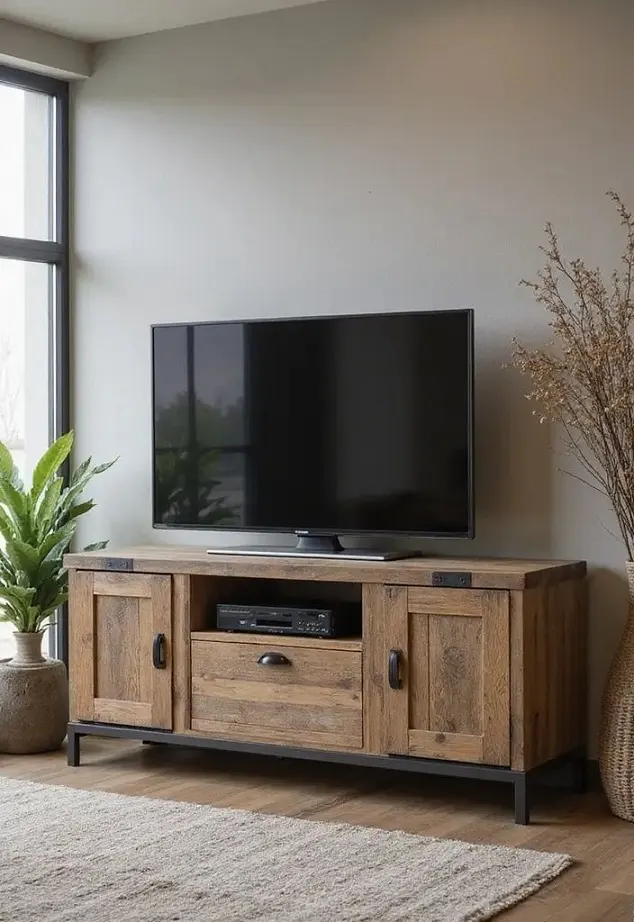
Engineering the Modern Anatolian Mill: Woodworking Machinery, CNC Automation, and Capital ROI for Aged and Distressed Solid Wood TV Units in Türkiye provides an authoritative, practitioner-level capital equipment and factory engineering guide for Turkish factory owners, industrial wood products engineers (Ağaç İşleri Endüstri Mühendisleri), machinery suppliers exhibiting at WoodTech Istanbul, and international buyers auditing plant technological capabilities.
Manufacturing solid wood TV units with an aged and distressed look in Türkiye presents unique mechanical and thermodynamic challenges on the factory floor. Unlike flat-pack particleboard production—where uniform melamine panels pass through standardized edge-banders—distressed solid oak, walnut, and chestnut consoles require processing dense, knotty character hardwoods (imported NHLA Common-grade American white oak and European Wildeiche alongside domestic Anatolian chestnut and steamed beech) without blade tear-out, glue-line starvation, or dimensional warping. Investing in the right machinery stack compresses production lead times from 60 days to under 30 days, slashes raw hardwood waste by up to 18%, and guarantees tight batch-to-batch tolerances across multi-container export orders.
Throughout Engineering the Modern Anatolian Mill: Woodworking Machinery, CNC Automation, and Capital ROI for Aged and Distressed Solid Wood TV Units in Türkiye, we dissect the complete factory-floor equipment architecture—evaluating computer-controlled compartment and vacuum drying kilns, rough-mill optical scanners and high-frequency stave presses, 5-axis CNC routers for tambour doors and steel C-channel routing, multi-head planetary wire-brushing and distress-texturing machines, pressurized spray booths and UV-oil roller lines, biomass energy recovery economics, and capital payback calculations.
1. Kiln-Drying Infrastructure: The Thermodynamic Foundation of Export-Ready Solid Wood TV Units
Every successful plant operating under Engineering the Modern Anatolian Mill: Woodworking Machinery, CNC Automation, and Capital ROI for Aged and Distressed Solid Wood TV Units in Türkiye begins at the lumber yard. Because Türkiye imports rough-sawn European oak (Quercus robur) and exotic hardwoods at 16%–25% moisture content—and harvests domestic Black Sea beech (Fagus orientalis) and chestnut (Castanea sativa) at 45%+ green moisture—in-house kiln capacity is the single most critical capital asset separating tier-one export factories from vulnerable small workshops.
Conventional Compartment Kilns vs. Vacuum Dry Kilns
1. All-Aluminum Computer-Controlled Compartment Kilns (e.g., Mühlböck, Nardi, Baschild):
• Architecture: Insulated anodized-aluminum chambers holding 50 to 150 cubic meters (m³) of stickered lumber per charge, equipped with reversible high-velocity axial fans, modulated hot-water/steam heat exchangers (fed by wood-waste biomass boilers), and multi-zone capacitive moisture probes.
• Cycle Economics: Drying 38 mm (6/4) rough-sawn character white oak from 20% down to 8.0%–10.0% Moisture Content (MC) takes 14 to 22 days, including mandatory high-humidity equalization and stress-relief conditioning phases that eliminate internal case-hardening.
2. High-Efficiency Vacuum Dry Kilns:
• Architecture: Heavy-walled cylindrical or rectangular steel pressure vessels operating at sub-atmospheric pressure (150–250 mbar), lowering the boiling point of water inside wood cells to 45°C–55°C.
• Cycle Economics: Cuts drying times by 60% to 75% (stabilizing 50 mm thick solid walnut or oak leg blanks in 3 to 5 days) with virtually zero surface checking or tannin discoloration—ideal for agile custom OEM/ODM orders and urgent rush shipments.
2. Rough Mill & Stave Lamination Automation: Maximizing Character Hardwood Yield
Rough-sawn character oak and rustic walnut boards contain natural knots, checks, bark pockets, and irregular edges. Under Engineering the Modern Anatolian Mill: Woodworking Machinery, CNC Automation, and Capital ROI for Aged and Distressed Solid Wood TV Units in Türkiye, automated rough-mill lines convert irregular boards into dead-flat, structurally balanced solid wood panels while minimizing offcut waste:
Rough-Mill & Panel Machine Core Engineering Function Technical Precision & Output Benchmark Impact on Distressed TV Unit Quality & Cost
Optical Defect-Scanning Optimizing Cross-Cut Saw (Weinig / Paul) Laser/camera scanners map board width, knots, splits, and sapwood before high-speed cross-cutting Cutting accuracy ± 0.2 mm; increases clear & character lumber yield by 12%–18% Separates structurally sound aesthetic knots (for black epoxy filling) from unstable structural splits
Heavy-Duty 4-Side Moulder & Straight-Line Rip Saw Planes rough staves to exact thickness and dead-square glue edges in a single pass Thickness tolerance ± 0.08 mm at feed speeds up to 30–60 m/min Ensures invisible, gap-free longitudinal glue lines across wide 240 cm tabletops
Finger-Jointing & End-Press Line Mills interlocking 10–15 mm finger profiles into short 18–45 cm hardwood offcuts and presses into continuous boards Longitudinal tensile strength matching solid timber (EN 204 D4) Converts short offcuts into internal drawer boxes, plinths, and concealed partitions
High-Frequency (HF) Radio-Wave Panel Press Applies hydraulic side/top pressure while dielectric RF waves heat wet PVA/PUR glue lines selectively Cures a 240 cm × 50 cm × 30 mm solid oak tabletop in 90 to 150 seconds Multiplies daily tabletop output by 5× compared to manual cold-clamp racks with zero spring-back
Multi-Head Wide-Belt Calibration Sander (DMC / Büttfering) Calibrates glued panels flat with steel/hard-rubber contact rollers followed by orbital finishing pads Panel flatness within ≤ 0.3 mm across full width; progressive 80 → 120 → 180 grit Prepares perfectly uniform substrates for rotary wire-brushing and dead-matte coatings
3. Five-Axis CNC Machining Centers: Precision Joinery & Tambour Door Engineering
Once laminated solid hardwood panels leave the calibration sander, 5-axis CNC machining centers (such as Homag Centateq, Biesse Rover, or SCM Accord) execute complex structural joinery and kinetic features in a single clamping setup:
• Recessed Steel C-Channel & Figure-8 Fastener Routing: CNC routers mill precision 4 mm deep underside channels and keyhole slots for steel anti-warp stiffeners and expansion-permitting tabletop fasteners—guaranteeing zero seasonal splitting on wide-span TV consoles.
• Fluted Tambour Door Track & Slat Profiling: High-speed 24,000 RPM electro-spindles cut mirror-smooth curved or linear sliding tracks with exact tolerances (± 0.1 mm) for UHMW polyethylene glide strips, while 4-side moulders profile interlocking solid oak/walnut tambour slats bonded onto woven industrial canvas.
• 45° Lock-Miter Waterfall & Floating Tenon Joinery: Precision 5-axis aggregate heads machine interlocking 45° waterfall corners and mortise pockets for hardwood floating tenons, concealed Blum/Hettich undermount drawer slides, and M8 brass threaded leg inserts.
• Sub-Surface Blind Pockets for Smart AV & Qi Chargers: CNC routers excavate underside blind pockets leaving a 3.2 mm solid timber bridge for invisible 15W wireless charging coils, alongside bottom plinth chimney ventilation slots and rear magnetic access panel recesses.
4. Planetary Wire-Brushing & Mechanical Distressing Lines: Scaling Artisanal Texture
A signature technological breakthrough within Engineering the Modern Anatolian Mill: Woodworking Machinery, CNC Automation, and Capital ROI for Aged and Distressed Solid Wood TV Units in Türkiye is automating repeatable base texturing without sacrificing authentic hand-crafted individuality:
1. Multi-Head Planetary Structuring Machines (e.g., Costa Levigatrici, Viet, QuickWood):
Panels pass beneath contra-rotating planetary heads fitted with 0.35 mm twisted steel wire brushes (which excavate softer earlywood spring growth rings in oak and chestnut to a controlled 0.5 mm depth) followed by Tynex silicon-carbide abrasive nylon brushes that smooth micro-splinters while leaving hard latewood grain ridges raised in crisp 3D relief.
2. CNC Oscillating Edge-Distressing & Hand-Planed Relief:
Programmable oscillating gouge units apply organic, non-repeating edge wear along tabletop perimeters, complemented by master artisans at dedicated finishing benches who execute manual spokeshave chamfering, asymmetric chain/hammer bruising, and two-component black epoxy knot stabilization.
5. Pressurized Spray Booths, Ammonia Fuming Chambers, and Automated UV-Oil Lines
Applying reactive patinas and protective zero-VOC coatings safely and consistently requires specialized chemical application infrastructure:
• Sealed Negative-Pressure Ammonia Fuming Chambers (Füme Odaları): Stainless-steel-lined, gasket-sealed chambers equipped with automated ammonium hydroxide vaporizers and exhaust scrubbers allow factories to fume entire batches of European and American white oak consoles simultaneously—achieving deep, uniform through-fiber tannin oxidation without hazardous fumes escaping onto the shop floor.
• Positive-Pressure Water-Curtain & Dry-Filter Spray Booths: Filtered, temperature-controlled intake air eliminates dust nibs on ultra-matte (3–8 gloss) 2K acrylic-polyurethane topcoats, while electrostatic-assisted HVLP spray guns raise transfer efficiency above 75%.
• Automated Roller-Coater & UV-Curing Lines: For flat distressed panels and SKD components coated in Rubio Monocoat Oil Plus 2C or waterborne UV lacquers, automated sponge-roller applicators and buffing pad stations ensure uniform oil penetration and instant curing for immediate packing.
6. Central Cyclone Dust Extraction, Briquetting, and Biomass Boiler Integration
Modern Turkish woodworking plants convert environmental compliance into direct energy savings:
• Spark-Detected Cyclone Dust Extraction: High-static-pressure baghouse filters with infrared spark-detection and CO₂ extinguishing systems capture 99.5% of fine oak and beech dust—protecting worker respiratory health per ISO 45001 and EU occupational exposure limits.
• Hydraulic Briquetting & Closed-Loop Biomass Thermal Plants: Dry sawdust and planer shavings are compressed into high-density wood briquettes (4,600 kcal/kg) and burned in automated low-emission biomass boilers to heat the factory’s lumber drying kilns—cutting natural gas expenditures by 65% to 85% and lowering Scope 1 carbon footprints for European retail ESG audits.
7. Capital Investment & ROI Scorecard for Turkish Solid Wood Furniture Factories
For Turkish factory owners and industrial investors evaluating equipment upgrades under Engineering the Modern Anatolian Mill: Woodworking Machinery, CNC Automation, and Capital ROI for Aged and Distressed Solid Wood TV Units in Türkiye, the table below outlines typical capital expenditure (CAPEX) tiers, productivity gains, and payback horizons:
Machinery Upgrade Package Typical CAPEX Range (EUR) Primary Operational & Quality Gain Estimated Payback Period
In-House Compartment Kiln (80 m³) + Biomass Boiler €140,000 – €220,000 Eliminates external kiln fees, guarantees 8%–10% MC, cuts kiln gas costs by 75% 18 – 26 months
Optical Optimizing Cross-Cut Saw + High-Frequency Press €180,000 – €290,000 Boosts character oak yield by 15%, triples daily tabletop lamination output 20 – 28 months
5-Axis CNC Machining Center + Automated Tool Changer €160,000 – €260,000 Cuts tambour/joinery labor hours by 60%, unlocks complex OEM/ODM exports 16 – 24 months
Multi-Head Planetary Wire-Brushing & Tynex Line €85,000 – €145,000 Replaces manual angle-grinder brushing, delivers uniform 3D grain relief at scale 12 – 18 months
Pressurized Spray Booth + Automated Hardwax Oil Roller Line €110,000 – €190,000 Reduces coating waste by 30%, guarantees ±2 GU sheen repeatability 15 – 22 months
Note: Eligible Turkish woodworking enterprises frequently reduce net CAPEX by 20% to 40% through Ministry of Industry and Technology Investment Incentive Certificates (Yatırım Teşvik Belgesi — offering VAT exemption, customs duty exemption on imported European machinery, and tax reductions) alongside KOSGEB and TKDK industrial modernization grants.
Conclusion: Industrial Precision Powering Artisanal Heritage
As demonstrated throughout Engineering the Modern Anatolian Mill: Woodworking Machinery, CNC Automation, and Capital ROI for Aged and Distressed Solid Wood TV Units in Türkiye, Türkiye’s rise as a global leader in weathered solid wood media furniture rests on the intelligent integration of European woodworking machinery with Anatolian artisanal finishing. By pairing computer-controlled drying kilns, optical yield optimization, high-frequency stave presses, 5-axis CNC joinery, and planetary wire-brushing lines with closed-loop biomass energy recovery, Turkish factories achieve superior dimensional stability, repeatable patina excellence, and rapid export scalability across every major global market.