Acoustic Engineering, Sound-Damping Hardware, and Quiet-Close Joinery in Solid Wood Bathroom Cabinet Models: Residential and Hospitality Noise Control
In high-density urban residences—from Bosphorus-side apartments in Istanbul to multi-family developments worldwide—and five-star hospitality suites, hard bathroom surfaces such as glazed porcelain, honed marble, and tempered glass reflect up to 98% of airborne sound energy. In these echo-prone wet zones, slamming cabinet doors, rattling glassware inside thin drawers, and vibrating plumbing pipes create disruptive structural and airborne noise that travels through shared concrete floor slabs and party walls. Acoustic engineering, sound-damping hardware, and quiet-close joinery in solid wood bathroom cabinet models transform bathroom storage from an acoustic amplifier into a passive sound-absorbing sanctuary.
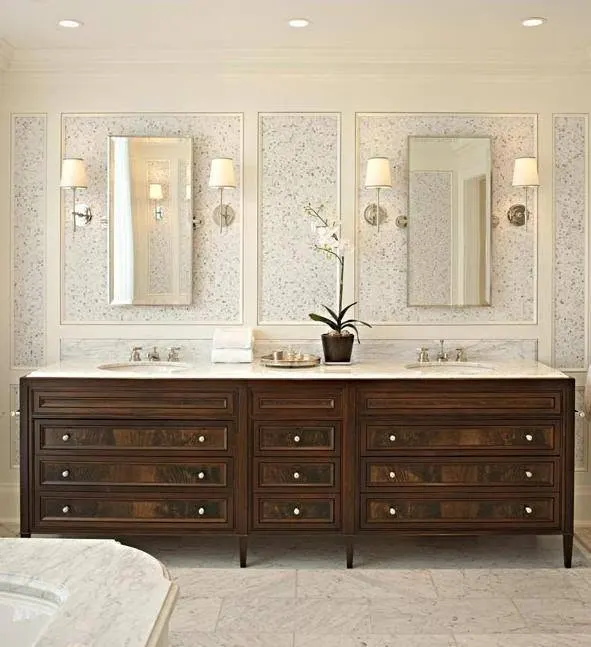
This comprehensive architectural acoustics and joinery engineering guide examines acoustic engineering, sound-damping hardware, and quiet-close joinery in solid wood bathroom cabinet models, detailing timber sound-absorption coefficients, hydraulic damper mechanics, drawer-base elastomer isolation, wall-borne vibration decoupling, and hospitality acoustic rating compliance (STC / IIC).
1. Bathroom Room Acoustics: Why Solid Wood Outperforms Metal and High-Gloss Laminates
Sound waves striking non-porous surfaces like glazed ceramic tile, glass shower screens, and high-gloss thermofoil cabinets bounce back with long reverberation times (RT60 exceeding 1.2 seconds in small tiled rooms), amplifying every sharp transient impact.
• Cellular Acoustic Damping of Natural Hardwoods: Unlike hollow steel lockers or dense, brittle melamine chipboard that ring like a drumhead when struck, kiln-dried solid hardwoods—particularly Anatolian chestnut (Castanea sativa), Turkish walnut (Juglans regia), and wire-brushed rift-sawn white oak (Quercus alba)—possess microscopic porous cell lumens and viscoelastic lignin structures that convert mechanical impact energy into negligible heat rather than airborne sound waves.
• Diffusive Surface Geometry (Fluted & Slatted Facades): Specifying CNC-fluted, reeded, or open-slatted solid wood bathroom cabinet models breaks up flat specular sound reflections, scattering mid- and high-frequency sound waves across varied angles to eliminate harsh bathroom flutter echo.
Cabinet Material & Facade Profile Impact Resonance Behavior Sound Diffusion & Absorption Profile Wet-Zone Acoustic Performance
Fluted / Slatted Solid Hardwood (20mm) Low structural ringing; high internal damping High — scatters reflections & absorbs via shadow gaps Superior — softens harsh tile echo in master & hotel baths
Flat Solid Hardwood with 2K Matte PU Warm, low-frequency damped thud Moderate — reduces high-frequency harshness vs. glass/tile Very High — eliminates hollow cabinet drum resonance
BS 1088 Marine Birch Plywood Carcass Multi-ply cross-laminated shear damping Moderate — glue lines between veneers dissipate vibration High — prevents box amplification of drawer slide noise
Melamine Particleboard / High-Gloss MDF Crisp, high-pitched mechanical clatter Low — smooth hard skin reflects sound specularly Moderate — amplifies hardware click and bottle rattle
2. Hydraulic Soft-Close Hinges and Fluid-Damped Undermount Drawer Runners
The primary mechanical noise source in bathroom joinery occurs during the final 30 millimeters of door and drawer closure. Acoustic engineering, sound-damping hardware, and quiet-close joinery in solid wood bathroom cabinet models eliminates impact slams through precision fluid mechanics:
1. Silicone-Oil Hydraulic Hinge Dampers: Tier-1 concealed European hinges (such as Blum Blumotion, Salice Silentia, and Hettich Sensys) integrate miniature sealed hydraulic cylinders filled with high-viscosity silicone oil inside the hinge cup. As the solid wood door swings past 35 degrees, a progressive piston meters fluid through micro-orifices, decelerating even heavy 22mm solid oak doors to a silent (< 28 dBA) cushioned close without bounce-back.
2. Synchronized Rack-and-Pinion Undermount Slides: Wide solid wood vanity drawers (90 to 120 cm) loaded with heavy glass cosmetic bottles often rack sideways when pushed off-center, causing metal runners to scrape. Full-extension concealed undermount slides equipped with lateral synchronization shafts and elastomeric roller carriages keep both runners moving in lockstep while absorbing rolling vibration.
3. Silicone Door Bumpers & Magnetic Catch Silencers: Applying recessed 2mm transparent shore-40A silicone hemisphere bumpers inside stile corners cushions final contact between door frames and carcass stiles, eliminating wood-on-wood knocking.
3. Eliminating Internal Drawer Rattle and Plumbing Vibration Transmission
Even with soft-close runners, opening and closing drawers causes glass perfume bottles, electric toothbrushes, and metal grooming tools to slide and clatter against hard wooden drawer bottoms.
• Closed-Cell EPDM / Neoprene Acoustic Drawer Liners: Lining solid maple or Baltic birch dovetail drawer bottoms with 3mm antimicrobial, waterproof closed-cell EPDM rubber or textured silicone mats isolates glass containers from the wood substrate, dropping rolling and sliding noise by 12 to 18 decibels while protecting wood finishes from cosmetic spills.
• Plumbing Pipe Acoustic Isolation Sleeves: Water supply lines and P-traps passing through cabinet back panels transmit water-hammer shock and drainage rush directly into the wooden carcass, turning the vanity into a sounding board. Installers must wrap all pipes passing through cabinet cutouts with 6mm closed-cell elastomeric foam grommets—never clamping rigid copper or PEX pipes directly against solid hardwood panels.
4. Structural Wall Decoupling for Floating Solid Wood Vanities
In multi-unit residential towers and luxury hotels—where strict STC (Sound Transmission Class ≥ 55) and IIC (Impact Insulation Class ≥ 55) acoustic codes govern shared partitions—bolting a floating vanity directly into a lightweight wall stud transmits drawer-closing vibrations straight into the neighboring apartment or guestroom.
• Elastomeric Neoprene Wall-Bracket Isolation Pads: Interposing 5mm high-density vulcanized neoprene isolation pads (Shore 50A–60A) and acoustic isolation washers between concealed steel wall-hanging brackets and structural wall studs breaks the solid structural bridge, attenuating structure-borne vibration transfer into adjacent rooms by up to 15 dB.
• Acoustic Sealant Perimeter Backing: When scribing tall solid wood linen towers or alcove vanities against tiled partitions, back the perimeter joint with closed-cell polyethylene backer rod capped with flexible neutral-cure acoustic sanitary silicone rather than rigid grout, preventing flanking sound leaks and structural vibration transfer.